
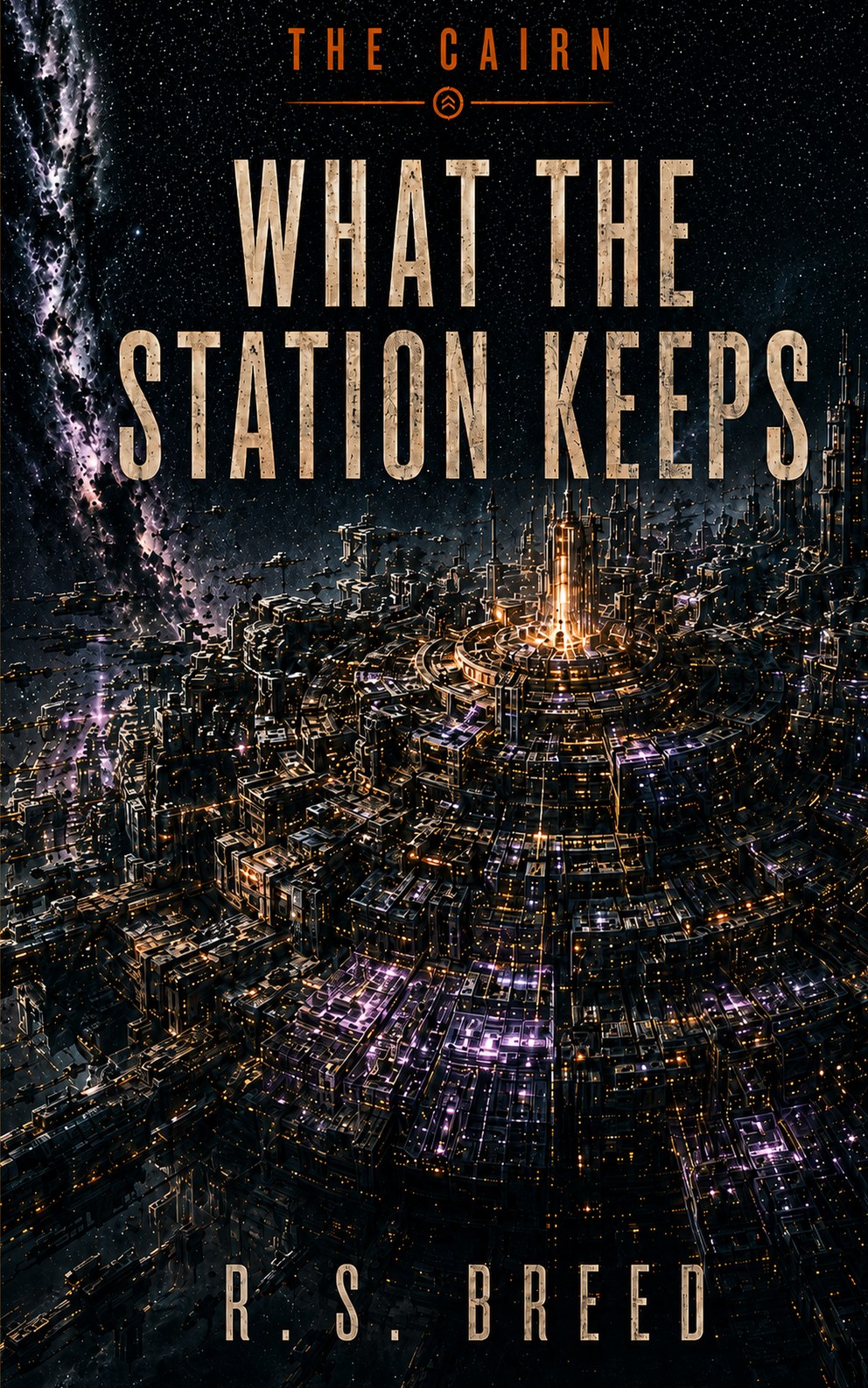
What the Station Keeps
The Cairn can keep its own sky lit — if the cost falls on somebody else's.
Twenty-four years after its founding, the Cairn is a hundred and ten thousand people — including an entire adult generation born aboard, who have never stood on a planet and never lived a year without the emergency authority that has governed the station since the attack. The power was meant to be temporary. It has been renewed annually without argument, and it is finally about to sunset. Then a transport comes in overloaded and off charter, carrying a returning expedition and proof that nobody forged and nobody ordered: a preservation measure that could keep the Cairn's own region of sky viable does it by moving the cost onto an inhabited sky downstream.
The founding principle was written when holding to it cost nothing: no one keeps their own sky lit by putting out somebody else's. Now the people who wrote it have to decide whether they meant it. Competing factions move to preserve, capture or destroy the emergency power before the decision can be imposed; the Cairn-born — adults now, and split every way their parents were — inherit the station and the argument together. The close of the saga settles what the Cairn's government actually possesses against the powers that founded it, and what it will refuse to do to survive.
Era
2342
Series
Book Five of The Cairn
Price
Kindle Unlimited
Book Five of The Cairn — the close of the station saga. A complete story on its own, and openly a culmination: it pays off all four books before it.
Wondering about order? Where The Cairn sits, and what to read first →
Listen free on YouTube
The complete novel, narrated — not a sample. 2 parts, in order below. If it holds you, the Kindle edition is one click up the page.
Chapter 1 — The First of the Quarter
The far walk on Six had been open four years and had a run of doors on it that had never been off their seats, and Cray had the head plate down on the second of them and the arm out on the deck before the trolley had properly stopped behind her.
“You’re ahead of the trolley.”
“The trolley’s slow.”
“The trolley’s got the tags on it.” Renko set the brake with his boot and came up the walk with the roll under his arm. “Tag it before the arm comes out. First of the quarter — somebody’ll be at your elbow about it inside the hour.”
Somebody was at her elbow before the tag was through the frame: a man out of the door opposite in his shift clothes with his cuffs already wet, wanting to know whether the walk was going to be shut, because his household was four and three of them were on the plant side and the plant side went at the second bell.
“Nothing’s shut,” Cray said. “It’s the quarter’s furniture. You’ll walk through all morning.”
“It’s on the deck.”
“That’s the arm. Door’s still up.”
The man looked at the arm on the deck for a while, and then went back in and left his own door propped.
None of it had been here when Cray was sixteen. The ring had stopped at the plant turn with a bulkhead across it and a stencil on the bulkhead, and now it ran on past the turn with doors on both faces all the way out to the stores end, and the plating underfoot was new plating and did not sound like the old. The walk had a smell of its own already — wet cloth and the fry oil somebody used at the far end and the flat mineral smell that comes up a new deck for about a decade and then stops.
Renko went down the leaf-edge with his thumb and did not like something at the bottom of it.
“Who fitted these.”
“The works side. In the year they opened it.”
“In a hurry, in a room somewhere.” He crouched and got his eye level with the seat. “Hung true on a bench. A ring isn’t a bench. There’ll be six out at the bottom, all the same way.”
There were six of them out at the bottom and they were all out the same way. Cray did the first four in the time it took Renko to do the fifth, and did not say anything about that, because there was nothing in it to say. Renko had done the fifth with the sixth already in his hands. The pin for it came out of his own coat and not off the trolley. There were four in the roll. There were always four in the roll.
The walk had a name on it that was not the one on the plating. The stencil at the plant turn gave it as the far walk, and everybody who lived on it and everybody who came up to see somebody on it called it the long end, because the first households in had walked it twice a day for a year before the ramp was cut through, and their children had it off them and used it before they could say which ring they were on. There was a bench at the stores end that the works office had never put there and had never come and taken away, and two men sat on it most evenings with a board between them.
The gang was Renko and Cray and the second-year out of the apprentice bay and a woman called back three days a quarter from the Seven-A boundary and never for a fourth. There had been four hands on Ring Six when Cray came onto it at sixteen, and Ring Six had been half the length. Nobody in the works office had ever put it to the gang that way. The office put it as the round: the round was every door on the ring’s sheet, twice a year, and the sheet had got longer and the round had stayed twice a year, and that was the office’s position on the arithmetic.
At the stores end the deck head was weeping over the walk in a slow bead that had made a stain the size of a hand.
Cray had the box under it and her light up into the void and both feet on the deck.
“Leave it.”
“I’m not in it.”
“You’re under it.” Renko came up the walk with the ladder. “What is it.”
“Wet stretch, above the joint. Been going since about the winter — the stain’s got a ring inside a ring.”
“That’s a good read.”
“It’s a stain.”
Renko put the ladder up and stood on the bottom rung a second longer than a man needs to before he goes up it. “Book it and put the hour on it. I’ll have it after the bloc line and I’ll have it with the pan.”
Cray booked it and put the hour on it. The book had the round down one side of the leaf, closers and arms and frames, dated, in her own hand; and the unions on the far side; and the far side had come to the foot of the leaf about two years ago and gone on over the fold onto the next one. Renko had never asked to see it. Cray had never got it out in front of him. It went back into her coat, and she held the foot of the ladder while he was up there, and passed him up what he put his hand back for.
The notice frame stood on the ring wall at the head of the walk where the ramp came up, and on the first of the quarter it was full.
Everything went in it: the water hours for the far end, which had changed and would change back; the sector counter’s hours; a hearing about a stall on the ramp; a hand-written sheet from a household on the second landing about a bag of tools that had gone off a trolley and would be taken back with nothing said; and, low on the left, half under the ramp notice, a printed half-sheet off the chamber clerk’s press about the renewal of the instrument, giving the sitting as the hundred and first day, the fold still in it from the office.
The works office’s booking was pinned across the top corner of the half-sheet, and Cray read the booking, because the booking had the hour of the bloc hold on it, and the hour was the third bell.
“Third,” she said, over her shoulder.
“Third.” Renko was doing something to the trolley wheel with his boot. “Then you’ve time to go and get the card.”
The sector counter was down at the ramp foot with two people in front of it and a clerk behind it eating out of a tin. Cray gave him the ring, the boundary, the frame number and the hour, and the clerk put down the tin and wrote it on the card, and put his name at the foot of it and the hour beside his name, and turned it round and pushed it across, all of it inside about a minute and a half, with the tin going back into his hand before the card was properly across the counter.
“Third to the fourth.”
“Third to the fourth.”
“Bring it back if you’re done early. Don’t bring it back tomorrow.”
Cray put the card in her inside pocket and went back up the ramp.
The heart floor was the way through to the works stores and always had been, and the stores had the pattern of arm the far walk was going to want six of, so she went across it. The pitches were up on their numbers with their stock out. The noodle counter had a queue at it. Two men were arguing at the shrine end about a delivery, amiably, the same argument going round twice.
The core stood where it had always stood, plated to about the height of two men and bare above that, and black from the plating up. The clean went round it at chest height as far as a person can reach over a rail, and stopped at the stores hatch, and where the brush had been over twice it had come up grey and streaked. A barrow of brushes stood at the stair foot with a card on it, and the card had a name on it and an hour, and the hour was eight years gone. People went past it to the stair and up.
The route office had one trestle now along the ledger face and the fair copy out on it under a rule, and a clerk at the far end of it going down a page with her finger and telling somebody in a works coat, without heat, that the hour he wanted had been on a sheet that burned, and what he had instead was her letters in the margin, and he could have a copy of the page with the letters on it and nothing else.
Cray took the stair two at a time and got the arms at the hatch, and the man there gave her seven and told her to bring one back rather than come up on Thursday for a seventh.
The bloc line at Six-B ran between the walk and the landing, and it had on it what every bloc line has: a leaf the height of two men, a jack point under a cover, a seal wire through the cover and through the eye, and a plant-side hand who stood at it during a hold and did nothing else during a hold.
Cray had the cover in her hand and her thumb on the seal wire before she had the bag off her shoulder.
“It’s wired.”
“It’s wired,” the plant-side hand agreed. “Was at the start of the watch. You’re the third one to put a hand on it this morning.”
“Then I’m the third.”
The card came out of her pocket and went across, and the plant-side hand read the name at the foot of it and the hour beside the name, and put it in her own pocket, and stood away from the frame, and that was the hold on.
Renko brought the second-year and the trolley through and they got the leaf back into its pocket on the winder, two-thirds and no further, and put the marked bar in and left it in, and the second-year stood at the bar. The landing side opened out beyond it, three floors of it up the face and doors all the way round each floor, with mats out and a smell of cooking and washing along the rails, and the noise of it coming down into the bloc line as one noise.
The furniture on a landing like that took the day and was the same job over and over: closer, arm, pin, seat, tag. Cray did the ground row down the left-hand side.
“How many’s on this one,” the second-year said, from the bar.
“On this landing?”
“On all of them.”
“Sixteen hundred and fifty-seven,” said the woman back from the Seven-A boundary, who had come down the row behind Cray with the pin roll and had done three doors to Cray’s five without looking hurried. “That was the roll and it hasn’t got any smaller.”
“On eleven landings,” Cray said.
“Eleven landings. All of it on our sheet, twice a year.” The woman got a pin through and moved down. “And a full ring of tagged handles up on Eleven that’s never been on any sheet.”
“They’re not going to open it.”
“They’re not going to open it this quarter. Get on the bar.”
The second-year got on the bar.
The hour went at the fourth bell. The leaf came back off the winder and onto its seat, and the cover went back on the jack point, and the plant-side hand put a new wire through the cover and through the eye and pulled it up, and gave the card back across the frame, and took herself off to the other end of the line.
Down the row, Cray came to a door with a woman standing in it — Nhál, grey to the wrist where the sleeve was pushed back, with a pot in her hands she had come out holding — who wanted to know whether the arm could be set to shut slower, because the door came to on her father and her father was slow at a door now.
“It can be set slower.”
“The office said it’s set at the standard for a bloc landing and it can’t be changed.”
“It can be changed.” Cray got the cap off the barrel and had the screwdriver in it. “It’ll want doing again in a year when the oil goes off. Whoever comes, make them shut it four times in front of you.”
The woman with the pot stood there and shut it four times in front of her, and then went in, and came out again about a minute later and put the pot down on the deck by Cray’s bag and went back in without saying anything about it, and it was still there, and still warm, when the row was finished.
The gang ate on the landing stair. There was a notice about sitting on the landing stairs.
Bel came along the rail at the second floor and down the stair with a reader case under his arm and his coat over the other, and sat two steps up from Cray, and had a picture on the reader before he was down.
“You’ll want to see this.”
“I’ll see it.”
“My cousin sent it. That’s a ring on Earth — not Earth, a station off Earth, but they run it off Earth, it’s the same office.” The reader went past Cray’s shoulder and down the stair to the second-year. “Look at the doors. Go along them. Every one of them is the same door.”
“That’s an office building,” the second-year said.
“It’s a residential ring.”
“It’s got a counter in it.”
“That’s the ring’s counter.” Bel took the reader back and went on with it anyway. “Every door the same. One pattern, one arm, one closer, one pin. Now, if the works office here bought one pattern — one, and stuck to it — you’d do this landing in a morning between three of you. You wouldn’t want a stores run. You wouldn’t want seven of a thing and a man telling you to bring one back. The whole ring’s slow because we’ve got forty patterns on it, and we’ve got forty patterns on it because nobody in that office has ever had to stand at a door with a screwdriver.”
“The frames are different,” said the woman back from the boundary, without any push behind it.
“Then change the frames.”
“Change every frame on the ring.”
“Over ten years. Do a landing a quarter. It’d pay for itself by the third year and then it’d go on paying, and at the end of it a fitter carries one arm and one pin and that’s the day’s kit.” Bel had got to the part where the arithmetic came out loud, and it came out loud, cheerfully, and went on a good while, and nobody down the stair went at it, because there was no getting at it and the food was hot. “And it’s the same with the chains. One turns. There’s one stood there that’s been stood there since we were sixteen, and it’s back in, and it’s been back in for years, and what it’s waiting on is a name on a board. That’s all that is. It’s a man with a pen and a morning.”
“Four turns,” Renko said. “Three’s uncertified.”
“That’s what I’m saying. It’s a signature.”
Renko ate.
Cray had the pot on her knee and ate out of it. What she had in front of her was the ground row done and the second row not, and a door on the back leaf of her book up on the walk above the ramp with an arm that had been dropping since the summer, on nobody’s sheet, because the household on it had never once said so at the office.
Bel put the reader away and told them all that he would bring the drawings up, because his cousin could get the drawings, and went off up the stair two floors to somebody who had not had it yet.
“He’ll have the drawings by the fortnight,” the second-year said.
“He’ll have them and they’ll be for the other station,” said the woman back from the boundary, and got up off the stair and went down the row for her pin roll.
Cray took the pot back to the door on the ground row and got it into the woman’s hands. The second row took the rest of the shift and was the same job as the first row.
At the end of it she came up the ramp with the bag on her shoulder and the ladder under her arm and went past the notice frame at the head of the walk.
A man had a stool up against the frame and was taking his own sheet down, because the bag of tools had come back on the Tuesday and he had said he would take it down and had not. The man got the pin out and the sheet off and the pin back into the cork so as not to lose it, and stood a moment with the sheet in his hand working out whether it was worth keeping, and folded it into his pocket, and moved the stool along to the water hours, which had changed again.
Who you’ll meet
Artefacts from this book
The archive →In-universe records, blueprints, and documents drawn from What the Station Keeps — the institutional paper trail behind the story.
The Emergency Instrument — the Renewal Chain
The paper trail of a temporary power becoming furniture. The emergency movement instrument was made on the twenty-sixth of the year thirty-four, in the worst fortnight the station ever had, with a fourteen-day sunset running to midnight on the face of it. It was renewed on the fortieth. It was renewed on the fifty-fifth, moved by the member for the voids, her name printed over the top at her own request. And then it was renewed, year on year, on the voices, unremarked — until the instrument of the hundred and first of the year forty-one, running a year to midnight, on the face of it and not in the minute, the same as every one before.
The Notice Frame, Ring Seven — First of the Quarter
The notice frame stands on the ring wall at the head of the walk where the ramp comes up, and on the first of the quarter it is full. Water hours that have changed and will change back. A hearing about a stall. A household's hand-written sheet about a bag of tools. And low on the left, half under the ramp notice, a printed half-sheet about the renewal of the instrument — the constitutional question of the age, pinned below a lost-property note, with the fold still in it from the office.
Bloc Hold Card — Third to the Fourth
A card the size of a hand, written across a counter in about a minute and a half by a clerk who put his tin down to do it and had it back in his hand before the card was properly across. It is the entire permission to hold one bloc line open for one bell. It is also the clearest statement anywhere of how a place on this station is named: ring, boundary, frame number, hour.
The Standing Offer of the Year Thirty-Four
An offer made to the Cairn in 2334 and never answered: the gang, the plant-down at every boundary on Ring Eleven, the holds, both boundary tests — all of it at the nine houses' cost, with no condition and no credit line attached. It has been minuted twice. It is still open. What stopped it was never money, and the minute clerk wrote down the one line that says so.
The Works Office — the Quarter's List
Petrak
The station at a hundred and ten thousand souls, seen from the desk that rations its hands. The works office keeps the quarter's heads chalked down a board the length of the wall, and the asks come to it in writing and get read back entire. On this quarter's list: a sector board's four-line sheet asking for a gang to walk Ring Eleven's second path — the one behind the lining, that turns out at every bloc line and comes back in — because a ring standing full of tagged handles cannot be opened on a path nobody has ever been along. What the ask needs is a gang on no other head, for two quarters. There is no gang. It goes on the list.