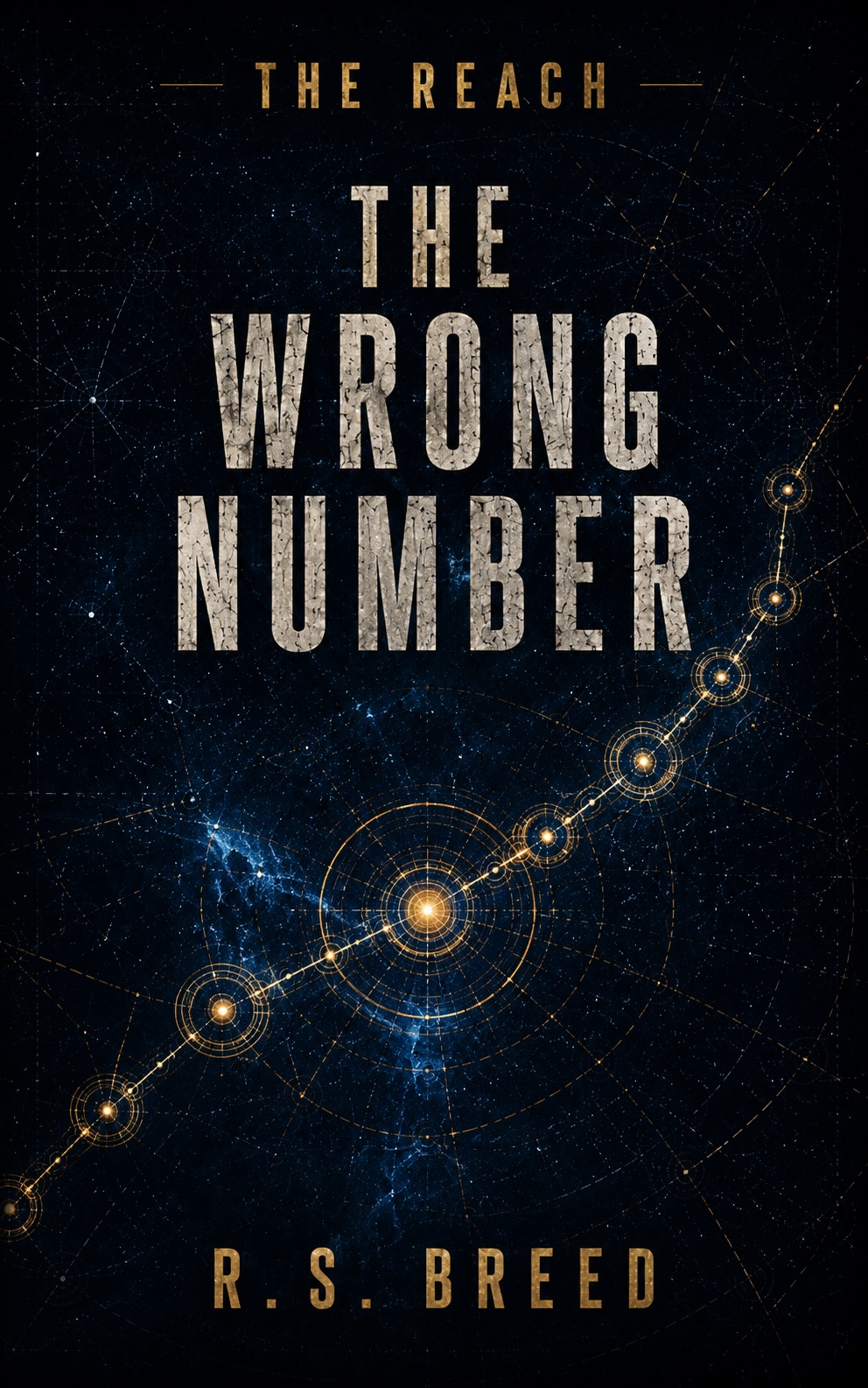
The Wrong Number
An armed explorer follows an empty tug into a frontier cargo corridor — and finds living people hidden inside a stolen freight stream.
The ISV Lodestar works the Rivas Corridor at the height of a frontier golden age — a chain of catcher stations flinging sealed mountains of cargo across the system and catching them gentle as freight, run by a captain, Daniel Cross, who buys real coffee with his own pay and still isn't tired of watching the catch come in. Then a tug arrives down the lane empty, where a crewed one should be, and the astonishment of the thing curdles into something worse.
Inside a stolen freight stream, Cross finds people — hidden, alive, and not supposed to be there — and a sabotage that is not the crime it was dressed up as. Book One of The Reach: a complete standalone frontier thriller, and the quiet opening of a cold war the people fighting it have not yet admitted is coming.
Era
2240
Series
Book One of The Reach
Price
Kindle Unlimited
New to R. S. Breed? The Wrong Number stands entirely alone — a clean way into the Fracture Cosmology with no prior reading required. Universe readers get an extra reward: the crew of Spent Light crosses into The Reach at Book Four, The Doorstep, when a ship five years lost falls home.
Listen free on YouTube
The complete novel, narrated — not a sample. 2 parts, in order below. If it holds you, the Kindle edition is one click up the page.
Chapter 1 — The Catch
The pods came in out of the dark like a city deciding to land.
From the Lodestar’s bridge they were nothing yet — a scatter of cold returns three thousand kilometres out, each one a sealed mountain of frontier cargo thrown across the system on a mass-driver’s say-so weeks ago, and now falling toward Tornel Station at a speed that would have flattened a continent if anyone had been careless enough to let it. Nobody was careless. That was the whole astonishment of the thing. Captain Daniel Cross stood at the rail of his own command chair and watched the catcher chain do what it did, and he did not pretend, even to himself, that he was tired of watching it.
The bridge smelled of real coffee. That was Cross’s doing and he was unrepentant about it: printer coffee was a perfectly adequate hot brown liquid, and he bought beans with his own pay at every station civilised enough to stock them, and on catch mornings he had the galley send the pot up, because some things you did properly or not at all. The morning watch had learned to time their arrivals to it. Around him the bridge ran with the low sounds he could have named blindfolded — the tick of Imeth’s board taking returns, the open engineering channel breathing static and the far-off note of pumps four decks down, somebody’s chair creaking as its owner leaned back further than regulation intended. Eight months out of the yard and the Lodestar still smelled faintly of new ship under the coffee, solvent and clean polymer.
“Geometry’s building,” said Imeth, from operations. The Nhál officer’s voice was level, unhurried, a careful speaker laying each word where she wanted it. “Tornel has solutions on the first forty. Confidence rising. The mitt is awake.”
“Let it cook,” Cross said, and drank his coffee.
On the forward display the catcher chain unfolded itself in light — a lattice of decelerator rings strung out along the Rivas line, each one a station in its own right, each one reaching out with fields no eye could see to take a falling mountain by the shoulders and talk it down. The pods answered. A return that had been screaming in on a flat ballistic line would touch the first ring and bend, lose a sliver of its murder, hand itself to the second ring gentler than before, and so on down the chain until the thing that had crossed a third of a system as a weapon arrived at Tornel’s docks as freight — grain and coil-stock and printer-feed, the ordinary substance of a dozen colonies that would eat this winter because of it.
Cross had grown up on this. His mother had gone from a drowned coast to a colony-engineering berth in the span of one lifetime, and she had raised him to understand that the catch was not a machine but a promise — the species reaching further than its grasp and then, by main cleverness and a great deal of borrowed Nhál physics, making the grasp catch up. Cross had been nine the morning her berth confirmation came through. She had read the message three times standing up in the San Diego kitchen, storm shutters still down from the night before, and then set the screen face-down on the counter and made his breakfast as if it were any other Tuesday — except that her hands would not settle, and she salted the eggs twice, and neither of them said one word about it. The eggs had been terrible. He had eaten every scrap. He had heard officers his own age call escort duty a babysitting run. He had never once been able to.
“Ackerman,” he said. “Tell me we’re not in anyone’s way.”
His executive officer did not look up from the contingency board. Commander Ruth Ackerman ran a bridge the way other people checked a parachute — twice, and again before the jump. “We’re a kilometre off the chain’s outer ring, holding station on the approach corridor,” she said. “If a pod sneezes we have eleven seconds and one good burn to be somewhere else. I’ve plotted the somewhere else.” A beat. “We are exactly as in the way as Geneva wants us to be, which is to say: visibly.”
“That’s the job.”
“That’s the job,” Ackerman agreed, in the particular flat tone that meant she had opinions about the job and was saving them for a better audience.
Cross let it go. The Lodestar was a Combine corridor’s worth of cargo from being needed for anything, and the bridge had the easy hum of a crew doing competent work in good order. Salazar lazed at the tactical-and-flight station with his eyes shut in a way that fooled nobody — the lieutenant could quote the range and bearing of every return on the plot, and had proved it twice this watch for the pure pleasure of doing it with his eyes closed. Vinter shadowed the helm beside him with the over-careful posture of an ensign who still could not quite believe they let him touch it, hands hovering a centimetre off the board. Hartley’s voice rose now and then from engineering on the open channel, dry and Mancunian and unhurried, conducting her morning argument with the port-side field coupling.
“Status on that coupling, Hartley?” Cross asked, mostly to hear the answer.
“Sulking, Captain.” The channel did nothing to soften the flatness. “It ran half a degree warm overnight and now it wants the whole deck to know about it. It’ll live. Tell the lieutenant the port lifter remembers his last landing, even if he doesn’t.”
“That lifter and I have an understanding,” Salazar said, eyes still shut.
“You have half of one, Lieutenant, and it isn’t your half.”
“Pod cluster two entering the chain,” Imeth said. “Tornel reports nominal. They’re catching well today.”
“They catch well every day,” Salazar said, not opening his eyes. “It’s the most boring miracle in the galaxy.”
“Lieutenant,” Cross said, mild.
“I’m complimenting it, Captain.” Salazar tipped his head toward the display without looking at it, the way a man gestures at weather he’s stopped noticing. “There’s nothing prettier than a thing that works. I just wish it’d let me fly something.”
“You’ll fly us home and you’ll be grateful.”
“It is beautiful, though.” Vinter said it to the forward display, quietly, and then went red to the ears when the attention of the whole bridge came round on him, because the ensign had not entirely meant to say it out loud. “The chain. As a piece of work, I mean. Sir.”
Salazar opened one eye. “He says it out loud.”
“Somebody on this bridge should,” Cross said.
“It is beautiful,” Imeth said from operations, without turning, in the way she had of agreeing with you more precisely than you had managed yourself. “It is also running ahead of its quarter’s schedule, which is rarer. Both are worth saying.”
Vinter sat a little straighter at the helm and pretended very hard to be checking his board. Cross caught Ackerman not-quite-smiling at the contingency plot, which from the XO was a standing ovation.
Two decades into the alliance, into the boom, into the brightest stretch of road the species had ever walked, and this was what it looked like from the inside: people at stations, ribbing each other gently, doing the marvellous as if it were Tuesday. Cross pressed two fingers to the rail, an old habit, tapped once, and watched the chain take the next mountain by the shoulders. Borrowed and built, his mother used to say. Half of it the Nhál’s and half of it ours and the marvel is that it holds. It held. It always held.
It stopped holding at 09:14 ship-time.
The first sign was nothing — a return on the legacy band, low and local, the kind of squawk the corridor’s old control net threw a dozen times an hour. Imeth’s hands, which had been resting flat on her console, did not move. But her head came up a fraction.
“Tornel control just lost a pod off its solution,” she said.
“Lost how?” Cross was already off the rail.
“Cleanly.” Which from Imeth was an alarm. “Pod four-one in cluster two. It was on the third ring’s books a moment ago and now the third ring believes it was never there. The pod is still coming. The ring is no longer reaching for it.”
Ackerman’s voice cut across the bridge before Cross could open his mouth. “Steering collar,” she said. “Somebody’s put a collar on it.” On the contingency board a thread of red peeled away from the orderly green of the cargo stream — one return, four thousand tonnes of frontier coil-stock, walking off the path the catcher chain had spent six hours preparing for it and onto a new one of its own.
“Confirm,” Cross said.
“Confirming.” Hartley’s voice came up from engineering, fast and dry and entirely without alarm, which was its own kind of alarm. “I’ve got a spoofed timing packet riding the legacy net — somebody’s feeding the chain a clock that says the pod’s twenty metres left of where it is. The ring corrected for a pod that isn’t there and let go of the one that is. That’s not a fault, Captain. That’s a hand.”
“Catch-riders,” Salazar said, and his boots came under his console, and the laze went out of him like a light switching. “They’re skimming the catch.”
Cross saw it the way he saw most things — all at once, and certain. Somewhere out past the chain a salvage crew with a legacy credential nobody had bothered to rotate out of the hardware had reached into a working catcher and peeled a pod off the top, smooth as lifting a coin off a stack. In a minute they would have a tug on it and a long quiet vector toward Sennen, and four thousand tonnes of somebody’s winter would evaporate from the books — written off as a miss, recovered under salvage rights by the very people the corridor had made and then thrown away. It was theft so elegant it was nearly bloodless.
Nearly.
“Where does it go if we do nothing,” he said.
“Through Tornel’s hold-three dock at about nine kilometres a second,” Ackerman said, without a flicker. “Which is occupied. Two hundred and ten people on the dock floor, give or take a shift change.” She had already done the sum. She had done the sum before he asked, because that was what she was for, and the doing of it was the only mercy she allowed herself.
Cross knew dock floors. Every escort captain did — you ate in their canteens between runs, you queued with the handlers for the same bad tea, you found out which supervisors would lend you a loader without making you sign for it. Hold-three at shift change would be a wall of noise: crews coming off rotation with their helmets under their arms, the oncoming watch bunched at the assignment board, two hundred and ten people thinking about lunch and leave and whose turn it was to call home. He set the mug down on the rail shelf with exaggerated care, as though the setting-down were itself a procedure.
So not bloodless. Not if the riders’ clever clock was a hair off, not if the collar fired wrong, not if the elegant theft hit a snag at nine kilometres a second with a station behind it. The riders would not mean to kill anyone. The pod would not care what anyone meant.
“Salazar,” Cross said. “Can you touch it?”
“I can touch it.” The lieutenant’s hands were already moving, and the swagger had gone somewhere very small and quiet, the way it did when the thing was real. “Point-defence, low yield, off the leading face. I don’t break it, I push it — a few centimetres a second back toward the chain’s envelope, let the next ring grab it on the rebound. But Captain —” and here he did look up, fast, because this part mattered — “I have to be inside the chain to make the angle. I have to put us between the pod and Tornel. If I miss, I miss with the station downrange and us in front of it.”
There it was. The whole job, distilled to one sentence the way the job always was: a captain could protect his ship or he could protect the catch, and the geometry would not let him do both, and the people who built the catch chain had never asked the people who flew the escorts what that felt like.
Cross gave it the half-second it deserved and no more. “Get us in front of it,” he said. “Ackerman, give Salazar the lane and give me the abort. Imeth, get Tornel off our backs — tell control to hold the third ring’s correction and trust us, I don’t want them reaching for that pod while Salazar’s nudging it, we’ll have two hands on the same mountain. Hartley —”
“Already pricing it,” Hartley said. “If we go where the lieutenant wants to go and the pod doesn’t cooperate, your abort burn costs more margin than I’d like to spend this far from a yard. You’ll get it. You won’t get it twice. Spend it like it’s the last one.” A pause, and then, drier: “Hull will take it. It’s the margin I’m watching, not the ship.”
“Lane’s yours, Lieutenant,” Ackerman said. “Abort’s plotted. Eleven seconds to the wall.”
“Eleven seconds is a holiday.” Salazar took the Lodestar into the chain.
There was no sensation of it — the drive was Nhál-smooth, the inertials ate the burn, and on the bridge the only sign that a fast cruiser had just thrown herself between a falling mountain and two hundred and ten people was the display tilting and the rings swelling huge across the forward view — frost-scarred plating, maintenance gantries folded against the spine, running lights strobing patient amber down a structure eleven hundred metres across that no crewed hull ever normally came near while it worked. Ackerman’s voice ran on low and constant at Cross’s right — lane margins, abort geometry, a litany with no fear in it anywhere.
“Ensign.” The XO did not look over. “You’re on the abort cue. If I call it, it goes to the lieutenant’s board before you’ve finished hearing me. Nothing else exists in your world.”
“Aye, Commander.” Vinter’s voice came out half a tone high and steadied on the second word, and his hands stopped hovering and settled onto the board.
A moment later a small sound escaped the ensign anyway — not fear, or not only fear; the sound a person makes when a thing they have read about their whole life turns out to be real and enormous and a metre from the hull. The boy had the good sense to swallow it.
“Pod’s tracking,” Imeth said. “Tornel is holding the ring. They are not happy, Captain. Control wants it on the record that they object.”
“Record their objection. Tell them I’ll buy them a drink.” Cross’s eyes were on the red thread and the green lattice and the gap between, which was closing. Nobody on the bridge was talking who did not have to. Somewhere below, faint through the deck, one of the point-defence mounts trained round with a sound like a door easing shut. “Salazar.”
“On the face — there.” The point-defence fired, a stitch of light too brief to be called a shot, more a tap than a strike, a few grammes of ablative breath against four thousand tonnes — and the mountain, which had been walking off toward a station full of people, broke stride. Just a fraction. Just enough. The red thread on Ackerman’s board bent, wavered, and began, with the vast reluctance of a thing that did not want to be told anything, to lean back toward the chain.
“Ring four has it,” Imeth said, and for the first time her voice carried something underneath the level — not relief, exactly. The Nhál did not do relief the way humans did. But something. “Ring four has it. The pod is back on the books. Tornel control reports —” the smallest pause — “Tornel control reports they are withdrawing their objection.”
The crew came off it raggedly, no two of them in the same instant. Salazar’s whole frame dropped half an inch as the tension let go, and a laugh came out of him one note too loud for the joke he hadn’t made. Vinter peeled his fingers off the helm board one at a time. On the open channel Hartley blew out a breath and informed nobody in particular that the burn had cost more margin than she’d priced and the bridge was not to make a habit of it. Cross’s own hand ached; his two fingers were still pressed flat to the rail, white at the knuckle, and he made them let go. The loosening went through the bridge like a tide turning, and he allowed himself one beat of it — one — before the part of him that his mother had built said and the riders are still out there.
“Still beautiful?” Salazar asked the helm, without turning round.
Vinter took a moment over it. “From slightly further away, sir. Yes.”
Somebody laughed — Ackerman, possibly, though nobody could afterwards have proved it.
“Where are they,” Cross said.
“Gone, mostly.” Salazar had the tactical plot up, frustration already curdling the edges of his voice. “Two craft, fast and light, running for the dark the second their collar slipped. They knew exactly how long they had. They struck on the geometry that gave them an exit and they took the exit.” He highlighted a single return, peeling away at the edge of the plot. “One’s slower. Riding heavy — looks like they got a pod off, just not the one they wanted. We could run it down.”
It was tempting. It was always tempting, the clean justice of a chase, and the pull of it reached Cross the same way it plainly reached Salazar. He looked at the slower return, the one limping off toward Sennen with somebody’s coil-stock in its arms, and he thought about two hundred and ten people on a dock floor who would clock out tonight without ever knowing how close the winter had come, and he made the call the chair made.
“No,” he said. “We’re an escort, not a hound. The catch is whole, the dock is whole, and chasing one light salvage boat across a corridor we don’t have jurisdiction over is exactly the kind of incident Geneva sent us out here not to start.” He turned from the plot. “Log it. Full sensor record, the spoofed packet, the legacy credential if Hartley can pull a signature off it. Somebody at Tornel is going to want to explain to me how a salvage crew that was struck off the contractor register five years ago still has a key to the front door.”
“You’ll find,” Ackerman said, in the tone of a woman who had read the corridor’s filings on the way in, “that the answer is it would have cost money to change the locks.”
“It usually is.” Cross dropped back into the chair, and the long muscles down his back reported, one by one, every minute he had spent standing braced without noticing. The catcher chain had already gone back to its work; the rings reaching for cluster three, the pods coming in, the most boring miracle in the galaxy resuming its boredom as if a mountain had not just been talked down from murder. Out past it all, too far yet to be more than a number on Imeth’s board, the big return sat where it always sat — the cargo train, the corridor’s quarterly mountain, eleven thousand pods marshalled into one ballistic mass and thrown weeks ago from a launcher half a system away, sliding toward Tornel on a schedule so reliable nobody on the bridge gave it a second glance. It would arrive when it arrived. The chain would catch it. The chain always caught it.
Cross gave it the second glance you gave a sunrise — there, and good, and not worth a thought — and looked away.
“Captain,” Imeth said.
Imeth had not moved. Her hands were flat on the console, very still, and her head was tilted the way it tilted when she was listening to something the rest of them had not heard yet.
“Imeth.”
“A status check,” she said. “Routine. The corridor’s escort tugs report in on an automated schedule — position, fuel, hull, every six hours, the most ordinary traffic on the net. One of them is overdue.”
“Overdue how much.”
“Forty minutes.” She said it the way she said everything, precisely, without weight, and the lack of weight was somehow the heaviest thing she could have given it. “It is nothing, Captain. Tugs miss a check-in. The net drops a packet. There are a hundred reasons and ninety-nine of them are dull.” She turned from her board at last, and set her hands one over the other in her lap, and looked at him. “I only note it because we caught a pod today that someone wanted gone, with a key that should not exist, on a corridor where a tug has gone quiet. I would rather note it now than wish I had.”
The bridge had gone still around them. Salazar’s plot still glowed with the riders’ vanished tracks. Ackerman had stopped writing. At the helm, Vinter looked from Imeth to the captain and back, too new to know whether this was a thing.
Cross looked at the number on Imeth’s board — forty-one minutes, now — and nothing in him answered: no premonition, no cold hand at the neck, only the ordinary captain’s reflex to close a thing before it opened.
“Flag it to Tornel,” he said. “Ask them to raise their tug on a priority channel and tell me when it answers.”
“And if it doesn’t answer?”
Cross was already turning back to the catch, to the rings and the falling mountains and the bright ordinary work of the best job in human history. “Then we’ll go and knock,” he said. “Politely. We’re guests out here.”
The tug did not answer.
Who you’ll meet
Artefacts from this book
The archive →In-universe records, blueprints, and documents drawn from The Wrong Number — the institutional paper trail behind the story.
ISV Lodestar — Blueprint
Captain Cross's armed explorer: a lifting-body hull that makes planetfall whole, kinetic mounts precise enough to act as a moving catcher, and the fold array of a true explorer. What a fleet built to discover looks like when it has to learn to fight.
Sling-and-Catch — Blueprint
The Sundgren Combine corridor-logistics system — a mass-driver "sling" that flings cargo across the system, and the chain of decelerator rings that catches it gentle as freight. The catapult, the catch, and the legacy control net the catch-riders walk through.
The Nhál Tongue — A Speaker's Field Primer
Contact Liaison Office
An ISCA Contact Liaison primer to the Nhál language — phonology, the three degrees of compounding, and a lexicon of standing-quiet and grief-debt. The translator renders almost everything; the words it leaves untranslated are the ones that matter.
Tornel Station — Corridor-Control Schematic
The catcher and corridor-control outpost that holds the mouth of the Rivas Corridor — a golden-age momentum-exchange station that throws ships down the lane and catches what comes home, on a schedule a whole region eats and breathes by. Populated, ageing, and carrying more than it was built for.
Cargo Manifest — Rivas Stream (Discrepancy Flagged)
D. Delgado · Lodestar
The public seam-ledger cannot be forged and cannot be erased — every movement in the Rivas corridor is recorded forever and proves its own author. So no one made these capsules disappear. They did something the ledger allows: they declared people as inert freight. This is the page where the declared numbers stop matching the physics.
Catcher Timing — Drift Log
Tornel Control · annotated D. Delgado
The catch is arithmetic done with momentum: a ring takes a falling mountain at exactly the right instant, or it does not take it cleanly at all. So the clocks that govern the chain matter more than almost anything in the corridor. This log is the record of those clocks beginning, very slightly, to disagree — and of the one fact that survives every repair.
Daniel Cross — ISCA-FC Service Record
Capt. D. Cross · ISV Lodestar
The personnel file of the officer ISCA Frontier Command just handed its newest armed explorer. It records a model career and a unanimous confidence. It cannot record the thing the next five years will take apart: that he believes.
The Four Blocs — Strategic Posture (2240)
ISCA-FC · Operations Directorate
The Centre's own map of the cold war it is managing — four powers, one expanding network, and a quarrel over who sets the speed. Read it for the confidence of an institution that believes it is the only adult at the table, and for the single claim it is most determined to dismiss.
ISV Lodestar — Senior Complement & Watch Bill
ISCA-FC · Personnel
The watch bill of an Aurora-class fast cruiser — eight senior officers and the ship that is small enough that the crew is the ship and large enough that losing one of them bites. The institution's flat list of the people the story is about.
The Aurora Class — Fleet Register
ISCA-FC · Vessel Registry
The class entry for the ship the era is built around — a small, fast, landing-capable explorer made possible by two decades of Nhál-assisted tech. The Lodestar and her sisters: what a fleet built to discover looks like just before it has to learn to fight.
We Kept Surviving — A Catch-Rider Broadside
posted anonymous · Rivas Corridor
The salvagers' side, in their own words — pasted to a relay mast in the Rivas Corridor and pulled down by a patrol. The grievance of people the golden age automated out of a living and then named criminals for staying alive. Not an apology. A bill.
The Survey Wardens — Threat Assessment
ISCA-FC · Operations Directorate
The Directorate's measured look at the fleet it has spent years pretending not to see — the Sundgren Combine's private warships, the 'survey wardens,' growing patchwork-legal on the lanes until the day they can no longer be overlooked.
The Bergen Charter (2127)
the Anchorage · Stave Press
The movement's own founding text — the document that turned a scattering of refusers into the Anchorage, and bound them, in writing, to do no harm to persons. Read it for the conscience the institutions classed as terror, and for the line its own splinters would one day break.