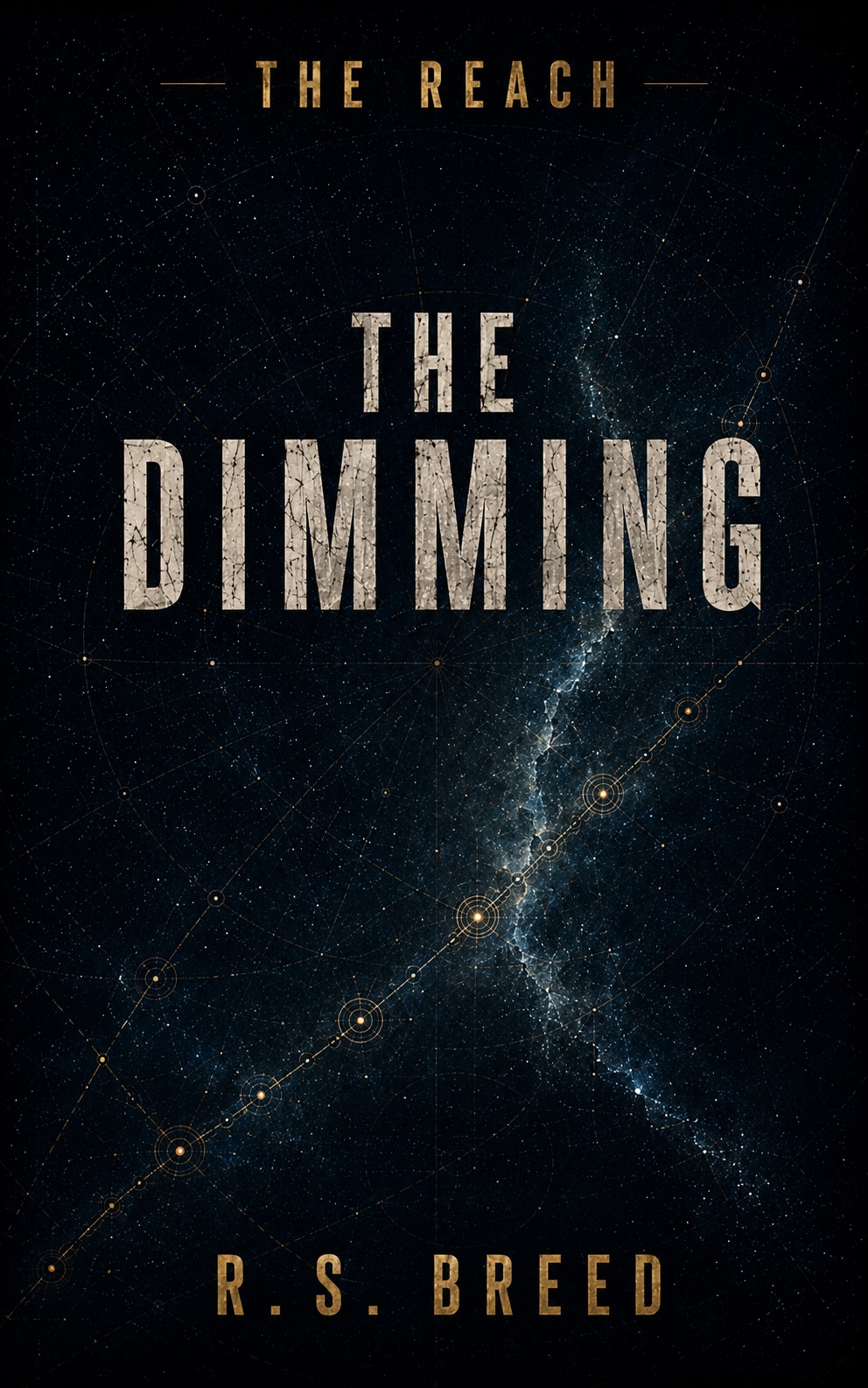
The Dimming
Humanity finally became worth saving. The universe does not care. The line holds — and then the line is not enough.
The fleet has fought its way to the one battle that can't be won cleanly. The enemy can't be out-gunned — only answered at a scale that asks everything of everyone at once. And the captain who built his whole life on being sure has to make the call in the open, with his name on it, and then live in the world the call makes.
*The Reach* is the action-adventure thread of the Fracture Cosmology — a five-book frontier fleet saga. *The Dimming* is the finale. Best read after *The Reach, Book 1 (The Wrong Number)*. The cosmology has many doors and no required reading order; other good first books are *The Signal*, *Cohort*, and *Signal Noise*.
Era
2245
Series
Book Five of The Reach
Price
Kindle Unlimited
Book Five of The Reach. Part of the one sequence in the universe written to be read in order — start at book one.
Wondering about order? Where The Reach sits, and what to read first →
Listen free on YouTube
The complete novel, narrated — not a sample. 2 parts, in order below. If it holds you, the Kindle edition is one click up the page.
Chapter 1 — The Watchline
The Longwake made no sound.
That was the first thing Mercer had hated about her, and six months in he still hadn’t talked himself out of it. The Endurance had been a noise — a body of noise, a deck that ticked as it cooled and groaned when she turned, a forward bulkhead that sang one low note whenever the drive came up because some fitter forty years gone had left a panel a millimeter proud. You learned the ship by her complaints. You knew where you were in her by what hurt.
This one didn’t hurt anywhere. He stood at the rail of her bridge with one hand flat on the cap and there was nothing under his palm but cold metal holding its temperature exactly, and a faint, even readiness, like a held breath that never needed to be let out. Everything worked. Everything had always worked. She had carried them out to the watchline in eleven days and not lost a fitting, not browned a single board, not asked anything of anyone.
Mercer counted the bridge instead. Six at stations. Brandt at helm, young still, though the war had taken some of it out of her face. Marsh at signals. Aldridge at tactical, square-shouldered, watching her board the way she watched everything now, as a thing that might be lying. Two ratings he’d learned the names of and one he was still working on. Six. He did this without deciding to. He’d done it on the Endurance too, every watch, the count that meant here is who I have and here is what I can lose. On the old ship the number had moved. A compartment a season, out there in the dark — frame-31, the five of them at the seal, Okeke’s arm. You captained a ship that took things from you and you learned the arithmetic of it.
The Longwake had taken nothing. Six months and she had not asked for a name.
Perfection read to him as a debt unpaid. He knew that was the wrong way to think and he thought it anyway.
“Hold,” he said, because Brandt had drifted them a half-degree off the mark without being told, correcting for a current that wasn’t there, the way you did on a ship that talked back. “She’ll sit where you put her.”
“Aye, Captain.” Brandt’s hands came off the yoke. The Longwake sat exactly where she’d been put. “Sorry. Habit.”
“Keep the habit. Just know it’s a habit here.”
The crew didn’t love her, and the dockyard hadn’t planned for that. They’d handed the Endurance’s survivors a ship that did everything the old one couldn’t — held a junction-edge without straining, ran her air sweet, took the cold of the watchline like it was a spring afternoon — and the survivors had walked her corridors for six months looking for the catch. Brandt printed her morning coffee from a galley unit that never clogged and drank it without comment, the way you’d drink anything in a stranger’s house. Aldridge had asked, the first week, where the manual overrides were for the targeting, and when Mercer told her the Longwake didn’t need manual overrides for the targeting she’d written down where they would have been anyway, in pencil, on a card she kept. They missed a ship that asked things of them. A ship you had to fight for became a ship that was yours; you bled into it and it took the blood and called the account square. This one carried them like luggage, and they resented being carried, and Mercer understood it exactly because he resented it too, and was the captain, and couldn’t say so.
What he said instead, most mornings, was the count, to himself, and let that be enough.
The Doorstep didn’t look like a door.
It looked like nothing — a stretch of dark off the bow where the stars went thin, and against it, strung in a slow geometry that took Mercer’s eye a moment to assemble every time, the Spanwatch Lattice. Anchors at the Nhál measure, the long ones, set wider than a human would have set them. Human buoys between, blinking their patient amber. And at the heart of it, dark, not blinking at all, the hull they’d built it around.
You couldn’t see her from here. You could see where she was by what she held. The Lattice drew its lines back to a place in the middle that gave nothing out, and that was the Endurance — or what they’d made of her after they took out everything that made her a ship and left the part that could do this. Her drive feeding the array. Her logic running the math no human board would carry. She’d hated her own noise and now she made none, because she wasn’t a ship anymore, she was a power source and a memory holding a junction shut by main force.
The Endurance had bought months. Bought was the word in every brief — like the junction was a thing you could put money against. The months were nearly run. Marsh had the clock somewhere on her board, ticking down to the day the Lattice stopped being enough, and nobody on the line said the number out loud, the way you don’t say a sick man’s weight.
The watchline was a working thing, and the work was mostly waiting and reading. Three hulls on station at the Doorstep this watch — the Longwake spanward, a Combine cutter holding the flank with its lights run down to almost nothing the way the Combine ran everything, miserly, and out past both of them a Nhál vessel keeping the long anchors honest, so far off and so dark that for whole watches you forgot she was there until Imeth’s people sent up a read in that even low register that meant all is as it should be. Twice a day a courier came through from the regroup with the loop — the war as it stood elsewhere, names and tonnage, who’d held and who hadn’t, a colony that had stopped answering its supply runs two systems over and a frontier captain named Marchetti who kept signing her reports with a joke at the bottom that the censors left in because morale was a resource now too. You read the loop and you learned the shape of a war you couldn’t see from here. Then you went back to watching a piece of dark do nothing.
Six months of that. Long enough that the new ratings had stopped flinching at the Nhál reads. Long enough that Brandt had a route worn into the deck plates between the helm and the coffee unit, and a way of saying quiet watch, Captain at the turnover that meant she’d checked everything twice. Long enough that the thing they were all waiting for had started to feel like a thing that might never come, which was the most dangerous thing a watchline could feel and every officer aboard knew it and none of them could help it.
“Marsh.” Mercer didn’t turn from the dark. “Read me the line.”
“Lattice nominal, Captain. All anchors answering. Picket’s quiet.” A pause that was Marsh choosing whether to add the rest. “Span’s holding at the projection. We’ve got — ” she checked, “the clock’s where it was this morning.”
“Good.” He let that be true for a second. The Lattice held. The Endurance was doing her last work and doing it well, which was a thing he could be proud of and a thing that turned in him like a swallowed pin, because the old ship deserved to die fighting and instead they’d hollowed her out to be a fence post. He kept that off his face. He’d learned to keep things off his face at a borrowed table a long time ago, watching men drink his father’s wine.
Down the bridge, Aldridge said, not loudly, “Picket’s been quiet eleven minutes.”
“Pickets are quiet,” Mercer said. “That’s the job.”
“Yes, Captain.” But she squared a stylus against the edge of her board, set it parallel, the way she did, and didn’t take her eyes off the dark.
The watch ran on. Brandt’s coffee unit ticked out a second cup somewhere behind him without being asked — the ship anticipating, the way she anticipated everything — and the junior rating he was still learning, a broad quiet kid up from the Endurance’s old engine gang, brought it to the helm without a word. Brandt took it. Didn’t drink it.
“She made it before I wanted it,” Brandt said, to the rating, low, not low enough. “Every morning. I haven’t pressed the thing in six months. It just knows.”
“Could turn it off,” the rating offered.
“I tried. It puts itself back. Says it’s a — ” she made a face, ” — comfort feature.”
“Brandt,” Mercer said.
“Aye, Captain.” She straightened. The complaint went off her like a light going out, and he was sorry he’d done it, because the complaint had been the realest thing on the bridge in a week — the sound of people who were still people, griping about a galley unit on a ship at the edge of a held junction. He’d wanted the line clean and he’d cut the one human thing on it, and he knew his father would have let the grumble run and poured another glass and been the better captain for it. He kept the regret to himself and didn’t apologise; you didn’t, on the bridge, in front of the watch.
What he said instead was: “Drink the coffee, Brandt. It went to the trouble.”
A breath. Then Brandt almost smiled, and drank the coffee, and for a moment the bridge was a place where people lived. Aldridge’s mouth did something at the corner that on Aldridge counted as laughter. The rating went back aft. The dark did nothing, the way it had done nothing for six months, and the Longwake held exactly where she’d been put, faultless, asking nothing.
The watchline had never been stiller, and not one of them aboard trusted the stillness, and not one of them could say why.
Hale’s instruments saw too well.
They’d built them off the Endurance’s own bones — the far-pocket gear, the readers that had stared into the dead side and come back with numbers. Delgado tuned them. Hale ran the science off the Longwake’s back, in a compartment full of light, and what came out of that compartment now was so clean it could measure the junction’s breath to a decimal no one had ever owned before.
Mercer had been glad of it for about a week. Then he’d understood what it meant. On the Endurance they’d flown half-blind and the dark could hide a great deal in the margin of their not-knowing. The Longwake could see. And the better you could see, the sooner you saw the thing you didn’t want to.
The thing he didn’t want to see had been there for weeks, and it was small. Delgado had brought it up to him twice, both times in that hedged way he had, the so-okay-so climbing as he talked: a number on the junction’s read that should have held flat and instead crept, by a fraction, by a fraction of a fraction, watch over watch, so slow that on the old ship’s instruments it would have lived forever in the noise and never been seen at all. Hale wouldn’t put a name to it. Hale wouldn’t put a name to anything; she laid the curve down on the board and let the curve speak and refused to say a word past what the curve said. The curve said the junction’s breath was getting a hair longer each time it breathed. Within tolerance. Inside every margin they had. Logged against the Lattice’s clock as an engineering cost and sent up the chain with a note that read monitoring, which was the only honest word anyone aboard had for it.
Mercer kept it in the same place he kept the count. A held junction got a little harder to hold every day, and the only ship in the line good enough to measure that was his, and he’d lie awake on it some watches and tell no one, because there was nothing in it yet you could give an order against. You couldn’t fight a number that was still inside tolerance. You could only watch it, on the best instruments anyone had ever flown, and hate that they were good enough to show you.
The board chimed.
It wasn’t a loud chime. The Longwake didn’t do loud. It was a soft two-note acknowledgment from Marsh’s station, the sound the line made a hundred times a watch, a node checking in or a node going down for service or a buoy passing its read up the chain. Mercer had stopped hearing it weeks ago.
“Node’s dropped,” Marsh said. “Outer picket. Spanward.”
“Which one.”
“Picket Nine. It’s — ” Her hands moved. “It’s just gone quiet, Captain. No fault. No distress. It stopped answering.”
“Eleven minutes,” Aldridge said, “and now this.”
“Different node,” Marsh said.
“Different node,” Aldridge agreed, in a voice that didn’t agree at all.
Mercer crossed to signals. The board showed him the Lattice as a web of lights, and out on the spanward edge of it, one light had gone to grey. Picket Nine. Furthest out. The one closest to the dark.
“Talk to it,” he said.
“Pinging.” Marsh sent the query. The web held its shape. The grey light stayed grey. “Nothing back. Could be the node. They go. We lost two last month, just hardware, the cold gets in the — ”
The grey light turned amber.
Marsh stopped talking.
“It’s back,” she said, and there was something careful in it now. “Picket Nine’s answering.”
“Then we’re fine.” Mercer watched the amber light blink its patient blink. “Read it.”
“Reading.” A second. Another. The Longwake’s board worked the way the Longwake worked, fast and silent and sure. “Authentication’s good. Signature’s clean — it’s our node, Captain, it’s checking out down the chain. Position’s good. It’s reporting nominal.”
“So it dropped and came back.”
“It dropped and came back,” Marsh said.
The captain should have let it go. A node went quiet, a node came back, the line was full of nodes and the cold was always getting into something. He’d have let it go on the Endurance without a second thought, because the Endurance couldn’t have told him any more than that.
But the Longwake could, and the trouble was the way Marsh was sitting.
“Marsh.”
“It checks out, Captain.” She said it the way you’d say a thing you didn’t believe but couldn’t fault. “Everything checks out. The authentication’s real. The signature’s real. The position’s — ” She brought the read up larger, and Mercer leaned in over her shoulder to see it.
Picket Nine reported its position as nominal. Station-keeping, on its mark, a few hundred meters of the slow drift any anchor ran, well inside tolerance. The number sat there, clean, authenticated, true.
“That’s right,” Mercer said. “That’s where it should be.”
“That’s where it should be.” Marsh’s finger came up to the board, not quite touching it. “But I had it twelve minutes ago. Before it dropped. And it wasn’t there.”
The bridge had gone quiet around them. Not the Longwake’s quiet — a held one, a human one, the kind the old ship used to make right before she sang.
“Show me.”
Marsh laid the two reads side by side. Twelve minutes ago: Picket Nine, here. Now: Picket Nine, here, a hand’s width off on the board, which out there was a great deal more than a hand. Both clean. Both authenticated. Both, the node insisted, nominal.
“It moved,” Mercer said.
“It says it didn’t. It says it’s where it’s always been.” Marsh’s voice stayed level and he could tell what it was costing her to keep it there. “Captain, the node isn’t broken. If it were broken I could tell you it’s broken. It’s passing every check we’ve got. It’s just — telling me two true things that can’t both be true.”
“Drift,” said Aldridge, who had come up on the other side of the station without being called. “Anchors drift. You said so yourself.”
“Not a hand’s width in twelve minutes. Not Picket Nine. And drift doesn’t — ” Marsh stopped. Started again. “Drift doesn’t authenticate, Aldridge. The node didn’t lose track of itself. It knows exactly where it is. Where it is just changed, and the chain agrees with it, all the way down.”
Nobody had a word for that. Mercer didn’t either. He stood with his hand flat on the back of Marsh’s chair and looked at the two reads that couldn’t both be true, and under his breastbone the old ship’s ghost note started up, low, where no bulkhead was.
Mercer counted the bridge. Six. Still six.
“Get me Hale,” he said. “And put the picket on the main.”
The main display gave him the dark, and Picket Nine in it as a single amber star.
The captain watched it. The watch watched it with him. Out on the science back, a channel opened and Delgado’s voice came onto the bridge mid-sentence, the way Delgado always arrived, already three words into the problem: ” — so, okay, so we’re seeing it too, the offset, we’ve got Picket Nine reading clean and reading wrong at the same time, and I want to say it’s the instrument except the instrument’s the only thing in this whole array I’d swear on, so — ”
“Delgado. Slower.”
A breath on the channel. “It’s not the node, Captain.” Quieter now, which from Delgado meant worse. “The node’s perfect. Whatever’s wrong, it’s not lying to us. It’s telling us the truth. The truth’s just — moving.”
“Moving how.”
“That’s the part I — ” and then Delgado didn’t finish, because the dark did.
It came up behind Picket Nine like dawn the wrong color. Not a flash. Not a flare. A slow lightening of the black at the spanward edge, the place the Lattice drew its long lines toward, the place the Endurance had been holding shut on a clock that still said they had time. The thin stars there thinned further, and then weren’t stars at all, because stars don’t move toward you in formation.
“Contact,” Aldridge said, and her voice went flat the way Mercer had waited six months to hear it go, all the doubt burned out of it in an instant, because here at last was a thing she could be sure of. “Multiple. Spanward, through the picket line. They’re coming in through the picket line, Captain, they’re already inside the — ”
“Numbers.”
“Working. More than I — ” Her hands flew. The board behind her threw up contacts faster than it could label them, a count that climbed and climbed. “It’s a wall, Captain. It’s a wall of them.”
The amber star that was Picket Nine winked out. Not greyed. Gone — overrun, swallowed, the node that had told them two true things sitting now in the middle of the thing that had made them true. Down the chain, Mercer knew, the Lattice would still be reading Picket Nine as nominal. On its mark. Holding station. Clean.
The clock said they had months.
The dark said otherwise, and the dark had the better instruments.
“Brandt.” Mercer was already at the rail, hand flat on the cold cap that gave him nothing back. The pin turned under his breastbone and he let it. “Bring her up. All of it. Whatever she’s got.”
“Aye, Captain — ” A catch. Then Brandt’s hands found the yoke and the Longwake answered, and for the first time in six months the perfect ship made a sound: a deep even rising note as her drive came up to full, smooth, faultless, asking nothing of anyone.
Mercer hated that she was perfect. He’d take it now.
“Marsh — get me the line. Get me Cross, get me Whitfield, get me anyone past us. Tell them the picket’s open. Tell them the watchline’s been holding a door that was already open.” He counted the bridge one more time, six faces turned out toward the wall of the dark, and put the count away where he kept things. “Combine cutter and the Nhál — are they up?”
“Cutter’s lit and turning, Captain. Nhál’s already moving — they were moving before I sent.” Marsh’s hands didn’t stop. “I have Whitfield’s relay. It’s three jumps back. Anything I send her arrives late.”
“Send it anyway. Send it twice.”
The wall resolved as it came. Not one shape — many, ragged at first and then not ragged at all, falling into an order as they crossed the dead picket, the way a thing moves when it has done this before and means to do it again. Aldridge’s board found edges for them now: hull-glints, drive-bloom, the cold geometry of ships under power. The lead element came on ahead of the rest, unhurried, taking the open door at a walk, and there was something in the walk of it that put the pin in deeper, because nothing that was about to fight came on like that. It came on like a thing arriving where it was expected. Where it had been expected for a long time.
“They’re not hailing,” Marsh said. “No challenge. No demand. Nothing on the band at all, Captain, they’re just — coming.”
“Lead element’s inside weapons in two minutes — ” Aldridge stopped, started again, the number rewritten by how fast the lead was closing. “Sooner. Captain, they’re inside it sooner.”
“Hold fire.” Mercer watched the lead come. It hadn’t lit a single weapon. It didn’t have to; he could see by the way it moved that it didn’t think it needed to. He had stood across a table from a man once who’d had a voice with no doubt in it anywhere, no seam in it where the difference could live, and the thing walking up the watchline now moved the way that man had talked. He knew the bearing of it before he had a name for the hulls. He’d seen what people who moved like that looked like up close, and what they did to a place after, and what they would not say while they did it. “Hold fire. Aldridge — hold.”
“Captain — ”
“They want us to shoot first,” Mercer said. “Then it’s a battle and they’re inside the line and we did it. Hold. Let them be the ones who open the door all the way.”
The lead element crossed the last of the distance and did not slow, and at the edge of weapons it lit, all at once, the whole of it, the way a city lights when the sun goes off it — and the Longwake threw up her own answer faster than any human hand, faultless, the perfect ship doing the one thing perfectly that Mercer had prayed for six months she’d never have to do.
“Now,” he said, and the watchline went loud.
The first salvo took the cutter’s flank before the cutter had finished its turn — the Combine ship rang on the band, a hull-strike, men’s voices over each other, and then the cutter’s guns came up and gave it back. The Nhál vessel out in the dark fired once, long, a single line of light that found something in the wall and unmade it, and the wall didn’t care, the wall closed over the gap and came on. Brandt put the Longwake across the lead element’s bow and the ship took the maneuver without a shudder, without a single board browning, and Mercer stood at the rail of his perfect silent ship now full of noise and counted — six, still six, six faces lit by the engagement, all of them his to lose — and out at the heart of the Lattice the Endurance went on faithfully reporting that everything was exactly where it should be.
“The door’s open,” he said, to no one, to the dark. “It was always open.”
And the war came in.
Who you’ll meet
Artefacts from this book
The archive →In-universe records, blueprints, and documents drawn from The Dimming — the institutional paper trail behind the story.
The Coastline — Approach Chart
The morning the coalition understood the door they bled for was a beach. The held Doorstep plotted as one mouth in a far larger approach geometry — a coastline whose extent no one can draw. The blank space is not empty. It is unsurveyed.
The Two Standings — A Contact Liaison Field Note on the Nhál
ISCA-FC · Contact Liaison Office
A field note on the two standings of the Nhál as they show on a human bridge — the ones who keep the silence, and the ones who left it to read the dark beside us. Not parties. Not a parliament. Two ways of meeting the dark, told apart by whether a word ever slips.
ISV Longwake — Vessel Register
ISCA-FC · Vessel Registry
The register entry for the ship a five-years-lost captain is given to replace the one he wore out coming home — a new Aurora-class hull, near-flawless, that can do everything the old ship couldn't. None of which makes her crew feel one degree safer.
The Ascendant — Fleet Contact & Threat Assessment
ISCA-FC · Threat Assessment Cell
The standing threat file on the force that comes through the far side of the held door — coordinated, disciplined, and led by something the people who have met it will only call 'the best of what's left.' Most of the fields on this assessment end in UNDETERMINED. The ones that don't are worse.
The Watchline — Spanwatch Lattice Status Board
ISCA-FC · the held Doorstep
The status board of the jury-rigged array holding the Doorstep — a lattice of a dead ship's heart, alien anchors, and human buoys, keeping a junction watched that was never re-sealed. It bought months. The board's bottom line is the months nearly spent.