
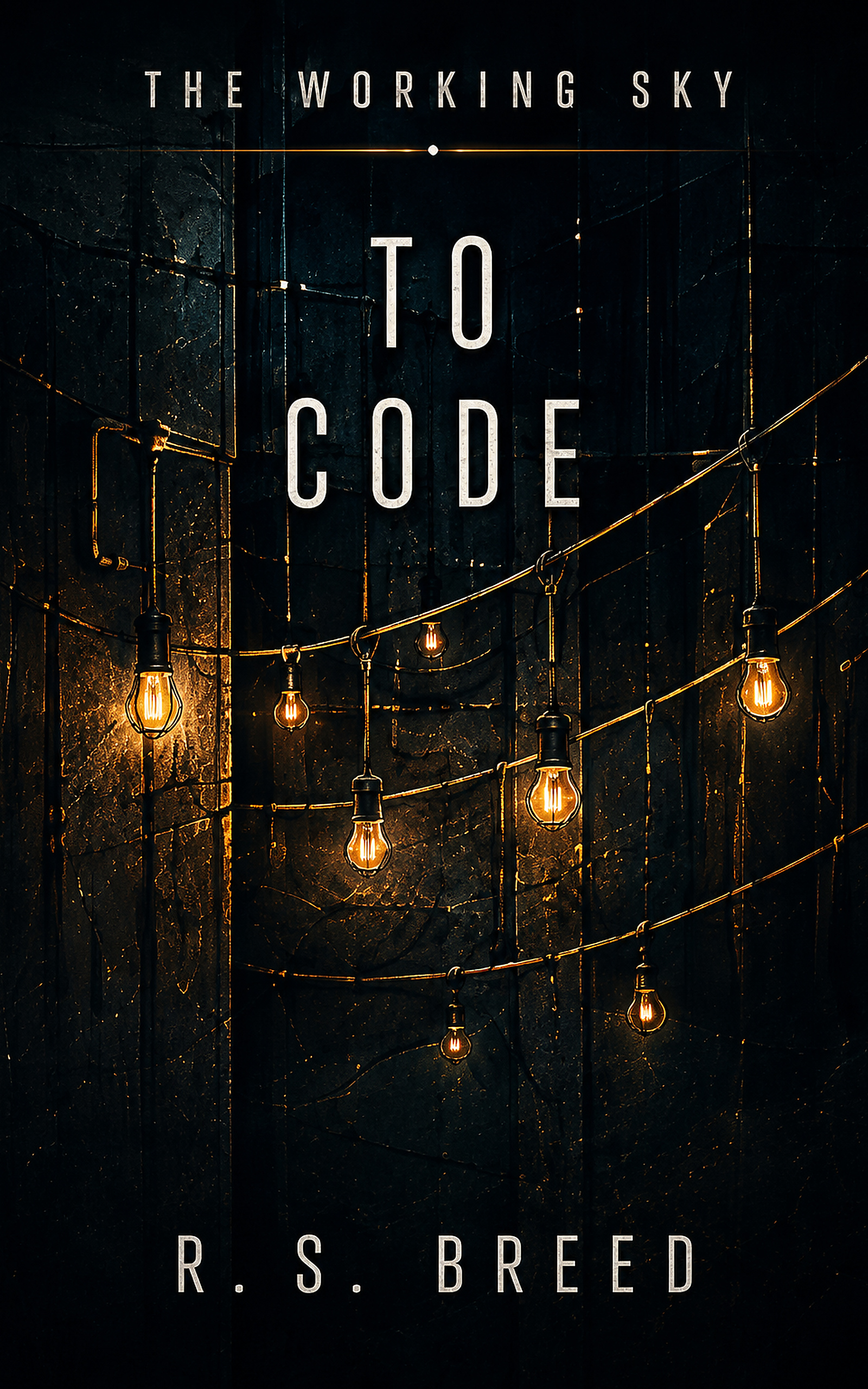
To Code
Some things are worth bringing into compliance.
Then he retires beside Walt Brody. Every winter Brody rigs thousands of individual lights across his house and yard in a pattern with no obvious symmetry, no sensible purpose and several increasingly questionable electrical details. Fisk measures the glare. He logs the hours. Eventually, inevitably, the township gets involved.
But the display is not decoration. It is a record of one particular night, built wire by wire because the official record gave it one paragraph. To Code is a complete standalone science-fiction short read about rules, memory and what a good inspector does when the thing worth preserving is not quite compliant. Set in the Fracture Cosmology. No previous reading required.
Era
2255
Series
A Fracture Cosmology Story of The Working Sky
A standalone short story in The Working Sky. Complete in itself — start anywhere.
Wondering about order? Where The Working Sky sits, and what to read first →
Listen free on YouTube
The complete story, narrated — not a sample. One video, the whole story. The Kindle edition is not out yet — this is the whole thing, free, in the meantime.
To Code
The lights went up on the first Sunday of November, and Howard Fisk, who had moved to Larkspur Court in March and had therefore never seen it happen, stood at his front window with a cup of coffee going cold in his hand and watched his neighbour empty a two-car garage of what he at first took to be the inventory of a small hardware store.
It took Brody four days. He worked evenings and all the daylight weekend, methodically, off two ladders and a scaffold plank, and he did not decorate the house so much as rig it — strings over the roofline, strings down the gable, strings out across the yard on posts Fisk had assumed all summer were for beans, a mast on the chimney with guyed arrays going out to the fence line on both sides, and everywhere, in no arrangement Fisk could discern, lights. Not nets. Not icicle fringes, which at least suggested a system. Single bulbs, placed, one at a time, each to its own position on the wire like a man setting type.
On the fourth evening, at 6:40, all of it came on at once.
Fisk’s kitchen went amber. The backsplash he and Dinah had chosen in the spring — a calm, disciplined grey — turned the colour of weak tea and stayed that way until 11:15, when the display clicked off on a timer and the room returned to itself.
“Huh,” said Dinah, who was doing the crossword. “There it is. The realtor mentioned it. It’s a whole thing, apparently.”
“It’s certainly a whole something,” Fisk said. He was at the window again. From here the display had no front, no face, no bilateral logic at all. Thirty-one years as a municipal building inspector had given Howard Fisk a deep working respect for pattern, for load paths, for the difference between complicated and careless, and what was hanging off the house next door was neither and both and it upset him in a way he could not immediately itemize. “There’s no symmetry to it.”
“Mm,” said Dinah. “Four letters, ‘to fret without cause.’”
Fisk let that go by an act of will.
The log started the second week, because a thing observed without documentation is merely an opinion.
Nov 9. Illumination 6:40–11:15. Est. 4,000+ lamps. Perceptible hum from N. array (transformer?). Bedroom curtains inadequate to occlusion.
Nov 12. Addition of second chimney array. No discernible design intent. Spoke to D. re: principle of the thing. D. unpersuaded.
Nov 14. Measured light at property line: significant. Measured again to confirm: confirmed.
Fisk went around, of course. He was not a man who went to a council behind a neighbour’s back; there was an order to these things, and the order began at the front door, at a reasonable hour, with a reasonable face on.
Walt Brody was about sixty, big through the shoulders in the way of men who have carried things for a living, and he listened to the whole of Fisk’s presentation on his front step with his head slightly tilted, like a man giving the matter genuine room. Fisk covered glare, the hum, the hours of operation, the question — raised respectfully — of what the display was for, given that it began three weeks before any recognized holiday and outlasted them all into January.
“You’re the inspector that retired,” Brody said, when he’d finished. “Fisk.”
“Howard.”
“Walt.” They shook, which was not how Fisk had seen the visit concluding. “I’ll get you the transformer spec sheet for the hum. It’s within rating but I can baffle it. The timer I can bring back to eleven sharp.” He considered. “The curtains I can’t help you with.”
“And the rest of it?”
“The rest of it stays up,” Brody said, without heat, the way you’d confirm a delivery date, and thanked him — thanked him — for coming around in person instead of writing to the township, and went inside.
The baffle appeared two days later. The hum stopped. The timer clicked at 11:00:00 in a way that Fisk, timing it across four consecutive nights, had to concede was flawless.
Somehow this made everything worse.
The petition, in retrospect, was where the whole enterprise began to take on water.
Fisk drafted it in the language of reasonable persons — the undersigned residents respectfully request a seasonal limitation — and walked it up one side of Larkspur Court and down the other, and learned in the space of a single Saturday the entire private constitution of the street. The Salcedos at number four signed it and then rang that evening to take their names off, no reason offered, a casserole dish visible in the background of the call. Old Mr. Petersen at number nine signed twice, once for himself and once for his late wife, “who hated it worse than me,” and Fisk did not have the apparatus to decline that. The Yoons wouldn’t sign but wouldn’t say why. The woman at number eleven signed with enthusiasm and turned out, on review of the map, to live on the next street entirely and to have a separate, unrelated campaign running about leaf blowers.
And at number seven, two doors up from Brody, the door was answered by a girl of about fifteen, lean, self-possessed, eating an apple, who read the whole petition standing in the doorway — actually read it, which nobody else had done — and then looked at Fisk with the flat courteous attention of somebody assessing a used vehicle.
“No,” she said. “Thanks.”
“May I ask why not?”
“We like the lights.” She said it the way you’d state a load rating. Behind her somewhere a man’s voice said, Senna, who is it? and she said, Petition, over her shoulder, and the voice said, We like the lights, and that appeared to conclude the matter for the household of Thorne.
Seven signatures, two withdrawn, one invalid, one deceased. Fisk filed the complaint with the township under his own name alone, attached his log, his photographs, his measurements at the property line, and — because thoroughness was not a tap he could turn off — a scaled site survey of the display itself: every mast, every span, every bulb position he could resolve through the good binoculars, plotted on grid paper over four evenings at the upstairs window.
It ran to forty-one pages. The clerk who took it said, “This is the most organized complaint I have ever been handed,” in a voice Fisk chose to hear as admiring.
Exhibit C was the bulb survey, and the trouble with Exhibit C was that it kept him up at night, and not in the manner of the lights themselves.
There was no symmetry to the display. He had said so in his cover letter: arrangement is arbitrary; no design logic is evident; the visual effect at the property line is of clutter without intent. But a man who has surveyed things for thirty-one years knows the difference between the scatter of carelessness and the scatter of accuracy, the way a thing looks when nobody cared where it went versus when every piece went exactly somewhere. Careless scatter has runs and clumps in it, the little accidental rhythms the hand makes when it isn’t thinking. Brody’s had none. Four thousand lamps and not one of them was where a man on a ladder would naturally have put it.
“It’s a pattern,” Fisk said to Dinah, on the third night of frowning at Exhibit C on the dining table. “It’s some pattern I don’t know.”
“Mm,” said Dinah, who was beside him addressing Christmas cards. Then she stopped writing, and looked at the grid paper a while — she had always been the one of them who saw the picture on the box, where Fisk saw the count of the pieces — and she turned the sheet ninety degrees, and said, in a different voice: “Howard. It’s the Dipper.”
It was. Rotated wrong, tipped past where the eye went looking for it, but there in the bulb plot at the twentieth scale: the Dipper. And once you had the Dipper you had the pole, and once you had the pole the whole survey went off like a struck match — the gable was the western sky, the bean-post spans were the ecliptic band, the chimney mast wore a string that was nothing at all unless it was Cassiopeia, and it was Cassiopeia. Fisk sat down slowly at his own dining table, in his disciplined grey kitchen, holding forty-one pages of municipal complaint against a man who had built the night sky over his house one bulb at a time.
Not the sky as it was, either. Fisk checked. That was the part he did at two in the morning, with the good binoculars and the survey and a star atlas of Dinah’s from a box in the attic, out on the cold back step, cross-referencing. The display was too full. It carried lights in positions where the atlas agreed something faint ought to be and the actual sky, checked and rechecked in the good seeing after midnight, now had nothing a person could swear to. He counted five of them, then stopped counting, because his hands were cold and because a man reaches a point where more data stops being the thing he needs.
The sky over Larkspur Court was thinner than the sky on Brody’s house. Everyone on Earth knew the sky was going; it had been going since the year Fisk retired; it was a fact you lived under the way you lived over bedrock, general and enormous and nothing to do with Tuesday. Brody had it bulb by bulb.
“There’ll be a date,” Dinah said quietly, from the doorway, holding her dressing gown closed at the throat. “A sky’s a date, Howard. If he’s built one, he’s built a night.”
The township, whose wheels turned slowly but did turn, issued its finding the last week of November: the display exceeded the seasonal-illumination allowance as to duration and extent; compliance — removal or substantial reduction — was required by December the sixth.
Fisk read the notice twice, put it in the folder with everything else, and drove to the library, where the town paper was archived to the founding. He told himself it was diligence. The word for it was older than that.
The display had first gone up, at a fraction of its current size, in November of 2247. The paper had covered it as a novelty item the following winter: LARKSPUR MAN’S GROWING TRIBUTE, four column inches, no detail, the word tribute doing no work the article would own. Fisk wound the archive back one more year, to the autumn of ‘47, and started reading forward, and it did not take long. That was the year of the sky — the release in the summer, the three weeks when it was every page of everything; Fisk remembered it himself, remembered his own office standing at the windows — and by November the fever had settled into a drumbeat, but that particular week the survey people had published a revision of the estimates, and the revision was unkind, and the paper gave it the front page and the two after that, the panels of experts, the diagrams, the special supplement for the schools.
Tobias Brody, aged eight, of Larkspur Court, was on page nine. A single-vehicle accident on the county road in the rain, a Thursday afternoon in November, school shoes in the footwell. One paragraph. The paper had been very busy that week; the universe was ending; there was so much to cover.
One paragraph, under three full pages about a sky whose loss would not be complete for three hundred years.
Fisk sat at the archive reader with his hat on his knee for a long time. He was sixty-six years old. He had spent his working life making sure that what men built would hold, and he had believed in it, the codes, the inspections, the stamped drawings, the entire modest apparatus by which a civilization keeps its roofs up, and not once in thirty-one years had it occurred to him that a man might build four thousand lights into the shape of one particular Thursday night because every other record of it was one paragraph long.
Brody was in the garage with the door up, at the bench, servicing bulb strings, when Fisk came up the drive on the second of December with the township notice in his hand and no plan whatsoever, an experience so foreign to him that he had stopped twice on the sidewalk to check whether he was really doing it.
“Come to measure?” Brody said, not unkindly.
“I came to—” Fisk stood in the garage doorway. The walls were shelved to the rafters with labelled crates: NORTH ARRAY. GABLE E. SPARES 40W. A workbench with a continuity tester, a soldering station, spools of wire in gauge order. It was — and this arrived in Fisk with something close to grief — the most beautifully organized garage he had ever been inside. “I came about the notice.”
“Sixth of December.” Brody nodded, unhurried, and went on cleaning contacts. “They were always going to get me on duration. Your file was good. The clerk let me read it.” He held a bulb up to the light, turned it. “That survey especially. You do nice work.” Then, setting the bulb down, in the same level voice: “The timer used to run till one in the morning, you know. I brought it back to eleven the year Peg asked me to. Not the year the street did. You can make of that what you like; it’s not the best thing you’ll learn about me.”
“The survey’s why I’m here.” Fisk found that his mouth had gone ahead without the rest of him, which had been happening, lately, to a man who had never once permitted it. “The sky. Your display — it’s the night of the fifth of November, 2247, from this latitude, isn’t it. That’s what I keep — the plot resolves to a date, and the date—”
“The fifth,” Brody agreed, mild as ever, and set the bulb down. “Cloud came in about nine that night, but earlier it was clear. He was out here with me. We were rigging the first strings that year — just the porch, that year, it was nothing, it was a bag of lights from the hardware — and it was the first hard-clear night of the fall, and everyone everywhere was carrying on about the sky, you couldn’t get away from it, and Toby wanted to know which ones were going to go out.” He wound a string slowly around his forearm, elbow to palm, the way men wind rope. “I told him nobody knew. Which was true then. And he stood out there on the lawn with his head back till his neck ached and made me promise that when they went, we’d put them back up. Him and me. He had it all worked out, the way they do at eight. One bulb a star. He was going to keep the list.”
The garage was very quiet. Out on the wire, the early dark was coming down.
“The Thursday after, it rained,” Brody said, and picked up the next string, and cleaned its contacts, and said nothing further at all, and Fisk stood in the doorway of the most organized garage in the county and did not say the fourteen useless things in the order they arrived, which was the first fully correct thing he had done since the first Sunday of November.
What he said, eventually, was: “Your splice on the north array’s low span is non-conforming. I noticed it in the survey. Insulation’s perished on the west leg too, and the load on that circuit’s at the margin. If the township’s minded to look for grounds, that’s grounds.”
“The splice stays,” Brody said. There was iron in it, the first iron of the visit. “That’s the porch string on that span. The first one — the bag from the hardware, the year he stood out there. It goes up every year and the splice goes with it. He made that joint. Eight years old. Ugliest joint you ever saw.”
“I know,” Fisk said. “I’m not asking you to remake it. I’m telling you the circuit around it has to carry less, and the leg needs re-insulating, and then it’s a monitored legacy joint on a compliant circuit, and I’d certify that.” He heard himself. Retired eight years, and I’d certify that, as though the stamp still lived in his coat. “And I’m telling you the duration finding can be appealed, and appeals want an engineer’s letter, and I have until the sixth.”
Brody looked at him across the bench for a long moment, the way he’d listened on the step in November, giving it its room.
“You wrote forty-one pages against me, Fisk,” he said. There was no anger in it. It was a man checking a measurement twice.
“I did,” Fisk said. “It’s the best documentation that display will ever have. When you and I are gone, some clerk’s going to find it in a file and know where every bulb went.” He had not known he thought that until it was out. “I’d like to amend the conclusions.”
The appeal went in on the fourth, eleven pages, Fisk’s stamp — kept current all eight years, renewals paid annually for no reason he had ever been able to give Dinah — at the bottom of a letter that described the display as a fixed seasonal installation of commemorative character, re-inspected under supervision, compliant save for one monitored legacy joint, retention recommended. The township, offered a signed engineer’s letter and the prospect of not having to send anyone up a ladder in December, discovered a discretionary allowance with a speed that told Fisk everything he had ever needed to know about enforcement priorities, and granted a variance through January.
They did the work over two cold evenings, the two of them, Brody up the ladder and Fisk on the tester, re-insulating the west leg, shifting load off the north circuit, bulb by bulb where it had to be bulb by bulb. Peg Brody brought cocoa out at nine both nights and stood a while with her arms folded, not looking at the display, looking at the two of them; the second night she put her hand once on the ladder, on its rail, the way you’d steady a thing that was in no danger of falling, and went back in. The splice they left exactly as it was, lumpy and over-taped and proud of the line, and Fisk wrote it into the record as agreed: legacy joint, monitored annually. He wrote the word annually and looked at it and let it stand, and in this way found out, in his own handwriting, that he intended to be here next year.
The girl from number seven turned up the second evening, hands in her jacket pockets, and stood watching them work with her flat assessing look until Brody said, “Strings in the blue crate, if you’re staying,” and she was up the second ladder before Fisk had worked out whether an unlicensed minor on a ladder was a thing he was prepared to see. She was good. She clipped in and moved along the roofline like she’d been born to rigging, which, Dinah told him afterwards — the street’s slow archive of itself — was close to the truth of it: the Thornes had come out of the war on a convoy, the two of them, the father and the girl, out of the actual dark that everyone else’s sky was only slowly turning into.
On the sixth of December the display came on at 6:40, complete, every star of the fifth of November 2247 burning over one house on Larkspur Court, including — Fisk knew their positions now without the survey — the five, no, by this winter the six: the faint ones, the edge-of-seeing kind that had gone first, burning nowhere now but strings and archives.
The street came out. That was the thing Fisk had not predicted, though his own wife could have told him, and had: the Salcedos on their porch with blankets, Petersen planted on the sidewalk with his stick, the Yoons’ kids cross-legged on the cold driveway slab, and half of them, Fisk saw now that he had the eyes for it, half of them came out every year, every first night, and he had petitioned these people in September’s ignorance and they had been too kind to explain, and had signed anyway, some of them, and taken it back after casseroles, and none of them had told him — or Dinah either. The street had been keeping it, all of them, silently, at once.
Greer Thorne came to the fence line and stood by Fisk for a minute, watching the lights with the unimpressed durable face of a man who had seen the dark do worse. “Good spread this year,” he said, which appeared to be his entire review.
And the girl, Senna, went up the Brody drive with something in her hand, and stopped at the low span of the north array — at the porch string; she had rigged two evenings beside it and knew the splice the way you know a scar on a friend — and clipped the something to the wire, where it hung small and blunt against the lights. A carved wooden dog, one corner worn soft.
“He can watch them from here tonight,” she said to Brody. “He doesn’t get cold.”
Brody looked at the dog on his son’s wiring for a moment, and then he did the thing with his jaw that Fisk had seen men do at exactly one other kind of moment in his life, at inspections of things that had held when it mattered, and he said, “No. He won’t,” and turned the timer’s key an hour past eleven, and nobody from any township said one word about it.
Fisk walked back across his own lawn in the amber wash. The grey kitchen glowed its weak tea. Dinah was at the window with two cups.
On the way in, Howard Fisk stopped at his own front step, and turned on the porch light — one bulb, sixty watts, nothing, a rounding error against the blaze next door — and left it burning, and went inside to stand with his wife at the glass, where the display filled the whole dark end of the street like the sky’s own good copy: the night of the fifth of November, 2247, preserved to a tolerance the original had not managed, holding.