
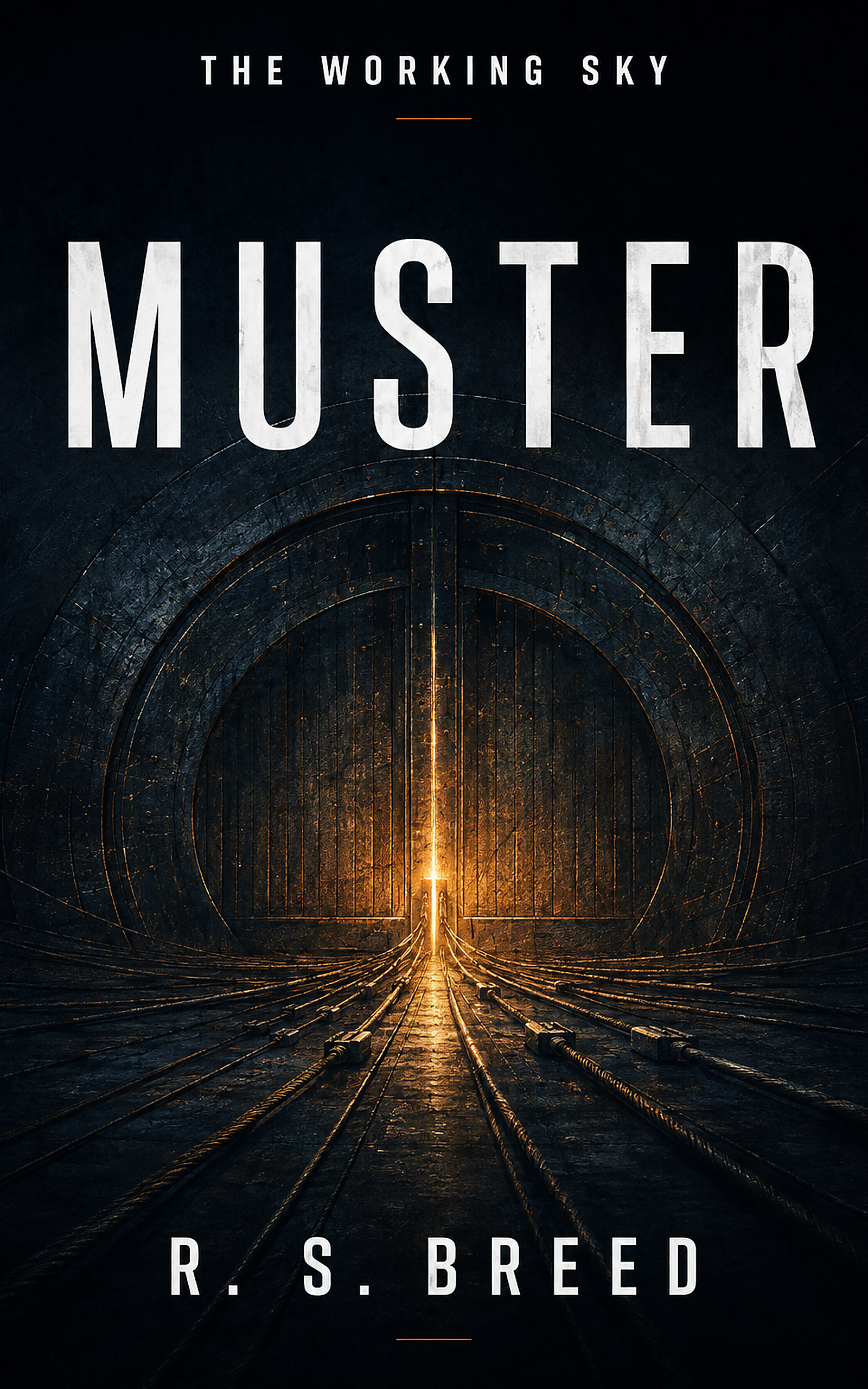
Muster
The drill ends. The work does not.
Shift change has run the same way for years: forty faces, two urns, exact coin, familiar complaints. June's other job as Section 9 warden is mostly an armband on a nail and one drill every spring.
Then a pressure breach seals the section. Two hundred and forty-one people are suddenly waiting behind June's muster line. Two names are missing. One of them belongs to a deaf old fitter. The other belongs to the seventeen-year-old apprentice who has gone back to find him.
Muster is a complete standalone science-fiction short read about ordinary competence when the drill stops being a drill. Set in the Fracture Cosmology. No previous reading required.
Era
c. 2330s
Series
A Fracture Cosmology Story of The Working Sky
A standalone short story in The Working Sky. Complete in itself — start anywhere.
Wondering about order? Where The Working Sky sits, and what to read first →
Listen free on YouTube
The complete story, narrated — not a sample. One video, the whole story. The Kindle edition is not out yet — this is the whole thing, free, in the meantime.
Muster
Shift-change at Gate Four ran to a timetable older than the paint, and June Hedley’s counter was the middle of it: the off-going watch wanting their tea strong enough to argue with, the on-coming wanting it fast, forty faces in twenty minutes and June with both urns going and the float short of small coin again, because the dock office had opinions about small coin and June had opinions about the dock office, and the two sets of opinions met, daily, in her till.
June knew the section by its teas. Marsden off the cranes, black, three sugars, first through the gate and last to leave the counter. The Vasquez twins from the sorting floor, one white, one peppermint, forever trading cups because June mixed them up on purpose to hear them complain. Old Dovel, fitter, forty years on the dock and deaf as a bollard the last ten, who did not queue — Dovel had never once queued — but appeared at the counter’s end like weather, and got his tea in the blue mug that was his, and got his biscuit set on the saucer’s east side where his thumb expected it, and paid with exact coin counted out on the steel, and nodded, and went. June had learned enough sign for good morning, strong today, and your apprentice is looking for you, which covered, in her experience, the whole of a working life.
The apprentice was Kip, seventeen, all elbows and loyalty, two years into learning everything Dovel knew, which the dock reckoned would take him forty more. The boy shadowed the old man through the section the way a dinghy shadows a hull, and had learned the signing fast and used it at volume, if signing can be at volume; Dovel maintained that it could and that the boy shouted.
On the wall behind June’s counter, between the rota and the port-fees notice, hung a yellow armband with WARDEN — SECTION 9 on it in letters that had faded two shades since anyone last needed them. Section warden was the sort of job you got by missing a meeting. June had missed the meeting twelve years ago — she said missed; Marsden, who had been at the meeting, said she’d been volunteered by acclamation the moment the door shut — and the duties had amounted, over the whole twelve years, to a drill every spring, a clipboard behind the biscuit tin, and the standing joke of the gate: mind yourself, June’s other hat is the law.
The market hall filled and emptied. The dome above Section 9 did what it had done for eighty years, which was hold the air in and the dark out, and be forgotten.
At six minutes past the hour, mid-pour, the floor arrived in June’s feet.
Not a bang. Later, giving her statement, she put it the only way it went: a thump you heard with your boots, and then your ears doing something wrong, a pressure-feeling like a lift dropping, and then every alarm in the section clearing its throat at once and settling into the two-tone nobody at Gate Four had ever heard outside the spring drill.
For the first ten seconds June was all habit. She turned off both urns. She took the armband off the nail and put it on, and took the clipboard from behind the biscuit tin, and by the time the section doors began their slow shut — Section 9’s doors were eighty years old and closed like eighty-year-olds, grandly, with announcements — she was on the gate side of her own counter with the list on the steel, and her voice, when she used it, came out in a shape she had never heard from herself: flat, loud, and impossible to argue with, the till-voice’s bigger sister.
“Gate Four musters here. Here. To me. Walk.”
They walked. That was the drill’s one gift — feet remembered it even while faces went white. The market hall emptied toward her in a slow river; the section doors went on closing; the two-tone went on; and June ticked the list in grease pencil, name by name, tea by tea — black-three-sugars, white, peppermint, the lip-reader’s blue mug — while the dock’s tannoy said the things tannoys say, breach indication Section 9 seaward face, sections sealing, remain at muster, in the voice of a man June knew took milk and no sugar and was doing his job well and slowly on purpose.
Pressure was falling in Nine. Not fast. The gauge by the gate — another thing nobody had looked at in years — was suddenly the most watched instrument on the dock, and its needle moved the way a needle should never move, patiently, in the wrong direction.
At four minutes in, with the doors a metre from shut, June’s list had two gaps in it.
Dovel. And Kip, who had been at the counter’s end not six minutes ago, and who was not in the river of faces, because — June knew it the way you know a thing your stomach worked out before your head — the boy had done the sum every person at that gate had done, the sum with deaf and two-tone alarm in it, and had gone back in for his fitter.
The doors shut at six minutes. That was the geometry of the next fifty-five: Section 9 sealed, June’s gate holding two hundred and forty-one people who were all somebody’s shift, a wall of eighty-year-old steel with a port of thick glass in it, and on the far side, somewhere among the stalls and the cranes and the patiently thinning air, an old man who could not hear the world ending and a boy who had gone to tell him in the only language that would carry.
June held the gate. She would have said, before that day, that holding a gate was a thing other people were trained for; it turned out she had been training daily for years, at the counter. People needed jobs and she had jobs. The Vasquez twins got the far stair, one each, to turn back fools. Marsden, who wanted with his whole crane-driver’s body to open the section door, got put in charge of the door — “you’re on the wheel, Marsden; nobody touches it, especially you” — and stood there with his hand on the locked wheel like a man holding a bird still, and did not touch it, the whole hour.
The count itself took three passes, because a muster list meets humanity coming the other way: two men answered for a third who “was just here,” which is not on the list of acceptable answers; one of the Vasquez twins answered for the other from the far stair and was made to walk back and answer in person, twin or no twin; and one of the sorters answered twice, once for herself and once, reflexively, loyally, for a cousin who — it emerged under June’s flat gaze — had swapped shifts three days ago and was at this moment asleep two sections away, the safest woman on the dock. June struck and re-ticked and struck again, grease pencil going blunt, and got to two hundred and forty-one twice running, and only then let the number stand.
The hard part of the gate was not the counting. The hard part stood at the rope June had strung from her counter to the stair rail, and was called Ellard, and his wife was a crane rigger, and the crane beds were in Nine. He did not shout. Shouting June could have handled; the drill had words for shouters. Ellard stood at the rope with his dock card in his hand, as if the right document would open the section, and said, quietly, every few minutes, to whoever was nearest, “she’s on the beds this shift, you see,” in the tone of a man explaining a small administrative error that could surely be put right — and June came back to him on every pass of the pot, and filled his cup whether it needed filling or not, and did not say she’ll be fine, because the warden’s clipboard had no line for promises. She said, “Wardens’ channel says the beds mustered inboard. List’s coming.” And when the list came at thirty-four minutes, relayed at a jog, June read down it with her thumbnail and found the name and turned the board around so the man could see it himself, in the runner’s bad handwriting, real: Ellard, P., crane beds, mustered, sixteen souls. Ellard looked at his wife’s name for a long moment. Then he folded up like a chair into the seat somebody pushed under him, and drank his cold tea in one go, and began, at once, being embarrassed — “course she mustered, she wrote the bed procedures” — and June moved on down the line with the pot and let him have his recovery the way she’d let him have his fear.
June poured tea. That was the part the dock talked about after, and the part June never saw the sense of the talk about, because the urns were hot and two hundred and forty-one people were staring at a sealed door, and what else would you do. She went down the muster line with the big pot and the stack of cups, name by name, and the ones who were shaking held the cups two-handed, and the ones who were not shaking held them anyway, and a man from the sorting floor she barely knew looked up through the high port where the dome glass showed its wedge of night and said, to nobody, “still up there, then,” about the stars, and drank his tea.
The runner came at forty minutes: wardens’ channel, relayed breathless. Two persons at the Section 9 inner door, requesting equalisation. Both upright.
The equalisation took nine minutes, which everyone at Gate Four spent looking at a door, and June spent looking through the port glass, where the lock’s own small window showed them at last, waiting in the lit box of the chamber: Dovel foursquare in the middle of it, hands easy at his sides, watching the gauge over the inner door the way he’d watch a slow weld — and Kip beside him with his right hand tucked up under his left arm and his face the colour of the steel, seventeen and upright, having crossed a thinning section on the strength of the sum he’d done, and found the old man at his bench — feeling for the alarm in his boots, Dovel said later, and packing his tools, because you don’t leave tools — and signed at volume, and brought him out the long way, and paid a hand for it at the last threshold, in the equalisation lock’s outer door, which closed like an eighty-year-old, grandly, without checking.
Dovel looked up, through the little window, through the port glass, down the length of the gate, and found June behind her list the way he found her behind her counter, and lifted his good slow hand, and signed — small, dry, across a sealed bulkhead and eighty metres of held breath — strong today.
June Hedley laughed. Two hundred and forty-one heads turned. She held up the pot.
The all-clear came at sixty-one minutes: a mooring lighter come loose at the seaward face and put its shoulder through an outer panel; the void between hulls had done its work; Section 9 held, and the pressure had found its level by the half-hour and stayed there; a yard crew was already at the panel with the patching frames. The two-tone stopped mid-phrase and left a silence with a hole in it, and the eighty-year-old doors began their grand announcements in reverse, and Gate Four’s two hundred and forty-one, plus two, were released back into the ordinary universe, which had been there the whole time.
Kip’s hand went to the medics: printed and pinned that evening, good as new by spring — the medicine was never the question, only the queue — and the boy sat on the trolley while they worked with the expression of someone assembling the story he would tell for fifty years, and told the first draft of it to anyone who came near, and every draft ended the same way: he was packing his tools. I’m signing the roof’s coming off and he’s packing his tools.
Dovel gave his statement in writing, in a fitter’s hand, four lines. The last line said: The boy came the long way round the crane bed, which was correct, and signed clearly. The dock framed nothing and pinned nothing — framing wasn’t its way — but June heard the yard master read that line out twice, once as information and once again, slower, for himself.
The counter reopened at the next shift-change, because that was when it opened. The urns came up to temperature on schedule, and before the gate filled June poured the first cup of the shift for herself, which she never did, and drank it standing at the counter’s end, in Dovel’s spot, and her hands were fine, and then for a moment they were not, and then they were fine again. The off-going watch wanted it strong and the on-coming wanted it fast, and the gauge went back on its peg, and the armband went back on its nail, faded, two shades quieter than the law, and at the counter’s end, at his hour, not queuing, Dovel appeared like weather — a plaster over one eyebrow, the blue mug’s saucer set with the biscuit on the east side — and counted out his exact coin on the steel, and paid, and then put down, beside it, separate, deliberate, one coin more.
June looked at the coin. Dovel picked up his tea and nodded at the urn: nothing on his face at all except the face he always wore.
June rang it into the till.